
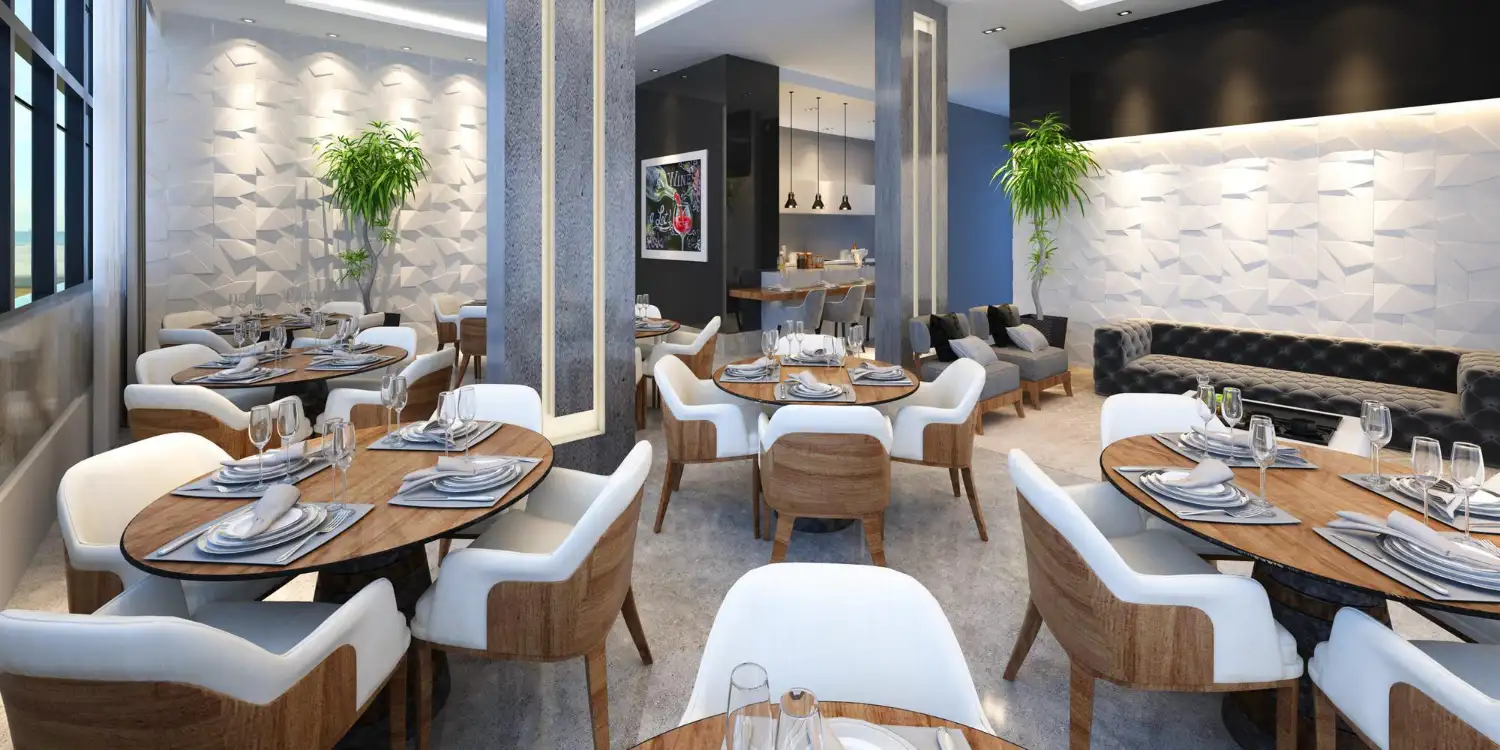
In practice, buyers rarely set out to source from a particular country. They set out to solve a problem, and Turkish restaurant furniture keeps appearing as the answer to a specific one: a project that needs made-to-order pieces, in weeks rather than months, without a container-load minimum.
That is a question about geography and industrial structure rather than about any single supplier. So this page looks at the country.
Specifically: what the production base actually consists of, how proximity changes a project timeline, where customisation genuinely happens, and where Turkey is the wrong answer.
Buyers choose Turkish restaurant furniture for four structural reasons: a domestic supply of beech, metal, foam and upholstery that keeps production in one country; a contract furniture industry built around hospitality rather than retail; road and short-sea freight to Europe measured in days rather than weeks; and order sizes that suit a single venue instead of a national rollout. Turkey suits made-to-order projects with real customisation. It suits pure catalogue buying and very large commodity volumes far less well.
Contents
- What Sourcing From Turkey Actually Means
- The Materials Base Behind the Industry
- Contract Furniture as a Main Business
- Geography, Lead Time and Visiting
- Order Size and Mixed Projects
- Customisation and Own-Design Production
- Standards, Testing and Documentation
- Working With a Turkish Factory in Practice
- Where Turkey Is Not the Right Answer
- How to Verify a Supplier
- Mistakes Buyers Make
- FAQ
What Sourcing From Turkey Actually Means
The phrase covers several different arrangements, and the differences matter more than the country label does. Turkish restaurant furniture arrives through at least three of them.
Three Things It Can Mean
First, it can mean buying from a factory that makes the pieces, from an exporter that buys them in, or from an agent who represents several workshops. All three describe themselves in similar language.
Our guide to restaurant furniture manufacturers sets out how to tell those three apart. This page assumes you have done that and are asking a different question: why the country at all.
Why Country of Origin Still Matters
In short, origin decides what materials are near the line, how quickly a sample can travel, and whether you can stand in the workshop on a Tuesday. Those are practical constraints rather than marketing claims.
Consequently two factories with identical machinery in different countries behave differently on a project. The machine is not the variable; the surrounding geography is.
The Shape of the Industry
Turkish restaurant furniture production clusters into a relatively small number of industrial districts, and component suppliers cluster around them. A frame maker, a foam supplier, a metal finisher and an upholstery workshop can sit within the same district.
Notably, that clustering is the underlying reason for most of what follows. Short distances between processes make short lead times possible.
The Materials Base Behind the Industry
An industry is only as flexible as the materials within reach of it. Four material streams sit behind Turkish restaurant furniture, and all four are largely domestic.
Hardwood
First, beech is the backbone of European contract seating, and Turkey has both domestic supply and long-established import routes for it. Oak and ash follow the same channels.
Because domestic mills process the timber, a change of species on a project does not require a new country. Our comparison of dining chair materials covers how each behaves in a frame.
Metal and Metal Finishing
Second, tube, sheet, welding capacity and powder coating are all local, and powder coating in particular is a mature sector. That matters because coating quality is where metal furniture usually fails.
Consequently a factory that coats in-house or a street away can correct a batch quickly. One that ships frames to another region cannot.
Foam and Upholstery
Third, foam production and a large domestic textile industry both sit inside the country. Turkey has been a significant textile producer for a long time, and contract upholstery grew alongside it.
So a covering change during a project stays a domestic conversation. Our restaurant chair fabric guide covers the specification side of that choice.
Stone, Laminate and Table Surfaces
Finally, Turkey quarries its own marble and travertine, and fabricates compact laminate widely. Our guide to restaurant table tops and bases compares the surfaces themselves.
| Input | Domestic | Why it matters on a project |
|---|---|---|
| Beech, oak, ash | Yes | Species change without a new origin |
| Steel and aluminium tube | Yes | Section changes stay quick |
| Powder coating | Yes | Colour matching and rework |
| Foam | Yes | Density specified per project |
| Upholstery textiles | Largely | Covering changes mid-project |
| Marble and travertine | Yes | Stone tops without a third country |
| Compact laminate | Widely fabricated | Sizes cut to your drawing |
| Speciality coated fabrics | Often imported | Adds time to the covering step |
Contract Furniture as a Main Business
In some furniture-producing countries, hospitality work is a sideline to domestic retail. Turkish restaurant furniture is not built that way. In Turkey it is a primary export sector, and that changes how a factory organises itself.
Built Around Projects, Not Ranges
By contrast, a retail-led factory optimises for making the same model repeatedly. A contract-led one optimises for making a hundred of a specification that did not exist last month.
Consequently the questions a Turkish contract factory expects are project questions: dimensions, finishes, quantities per model, delivery window. Those are the same questions your project actually has.
Hospitality Is the Domestic Market Too
Moreover, Turkey has a very large domestic hotel and restaurant sector, so factories serve demanding local buyers as well as export ones. A domestic market of that kind keeps standards honest without any export pressure.
Craft Alongside Machinery
Equally, upholstery and timber finishing remain skilled manual trades, and that skill base is deep. Machinery gives repeatability, and hands give the parts a machine cannot: a hand-finished edge, a matched stain, a curved back panel.
For example, fixed seating shows this most clearly, since a banquette run is effectively joinery. Our guide to producing a booth seating floor plan covers what a maker needs to build one.
Terminology and Habits
Besides, working with a country means working with its vocabulary. Our explanation of the restaurant servant covers one term that regularly confuses buyers, and it is worth reading before your first specification meeting.
Geography, Lead Time and Visiting
Distance is the least glamorous advantage of Turkish restaurant furniture and often the decisive one. Turkey sits between Europe, the Gulf and North Africa, and a project timeline feels that immediately.
Freight Time Into Europe
First, road freight reaches most of Europe in a few days, and short-sea routes serve the Mediterranean quickly. Deep-sea shipping from the Far East runs to weeks instead.
The difference matters most at the end of a project, when an opening date is fixed and the fit-out has slipped. Nobody recovers weeks of sea time, whereas days of road time sometimes compress.
Sample Movement
Similarly, a sample chair travels to a European city by courier in days. Sit on it, reject it, and a replacement arrives inside a fortnight. That loop is what makes genuine iteration possible before a production run.
Visiting the Factory
Likewise a flight from most European cities is a few hours, so a factory visit is a day trip rather than an expedition. Standing on a production floor answers questions that no email chain resolves.
Our guide to what to check before ordering tables lists what to look at once you are there.
Time Zone and Working Rhythm
Finally, Turkey overlaps the European working day almost completely and reaches the Gulf comfortably. A morning question reaches an answer the same day rather than the next one.
The afternoon on a factory floor that rewrites the order
Buyers spend weeks exchanging specification emails and then discover in ten minutes on a production floor that half of it was misunderstood. Seeing a frame in the jig, a covering under the light of the workshop and a finished unit beside a sample settles questions that photographs cannot: the real weight, the actual stain, how the joint is made, what the packing looks like. Proximity is what makes that visit realistic rather than theoretical, and it is the strongest practical argument for sourcing within a few hours of your own city. Go before the deposit rather than after the first container, and take your finish schedule with you.
One afternoon in the workshop → a specification everyone reads the same wayOrder Size and Mixed Projects
Volume expectations separate sourcing regions more sharply than anything else does. This is where a single venue feels the difference immediately.
Single-Venue Quantities
In reality most restaurants need dozens of chairs rather than hundreds, and a handful of each table size. Factories built for national rollouts treat that as an inconvenience; project-led factories treat it as normal work.
Mixed Orders
Furthermore, a real fit-out is chairs, stools, tables, tops, bases and often fixed seating. Getting all of it from one production floor keeps finishes matched and reduces the number of deliveries to coordinate.
Our indoor chairs, tables and bases and booth seating ranges share finishes for exactly that reason.
Phased Openings
Meanwhile groups opening in stages need the same finish in eighteen months’ time. A factory that keeps a specification on file and can rerun it matters more than any advantage on the first order.
Spares
Above all, ask for spare chairs and spare seat pads in the original run. Matching a covering or a stain later is far harder than adding a few pieces now.
Customisation and Own-Design Production
Customisation is the reason most buyers arrive at Turkish restaurant furniture in the first place. It works at three levels, and they are worth separating.
Level One: Finish and Covering
First, choosing a stain, a powder coat colour and a covering on an existing model is routine anywhere. Doing it without a large minimum per colour is less common.
Level Two: Dimensional Changes
Second, changing a seat height, a back height or a table size on a standard model is where project-led production separates from catalogue supply. A factory that cuts its own timber can move a dimension; one that assembles imported parts cannot.
Our guide to upholstered and non-upholstered chairs covers one common variation: the same frame built at different padding levels for different positions in one room.
Level Three: Your Own Design
Third, send a drawing or a reference photograph and have it produced. This is how hotel groups and designers get furniture nobody else has, and it is normal work rather than an exception.
Certainly expect a prototype step, and pay attention to it. The prototype is where a drawing meets a workshop, and it is the moment to change anything.
Fixed Seating
Banquettes and booths are custom by definition, since a room defines them rather than a catalogue. Sizing comes from your survey, not from a standard, which is why fixed seating suits project-led production so well.
| Region | Freight to Europe | Typical order size | Customisation | Visiting |
|---|---|---|---|---|
| Turkey | Days by road | Single venue upward | High, including own designs | Day trip |
| Far East | Weeks by sea | Container-led | Model-based, larger minimums | Multi-day journey |
| Western Europe | Days | Flexible | Varies widely | Day trip |
| Domestic assembly | Immediate | Small | Limited by imported parts | Local |
Standards, Testing and Documentation
Contract furniture has to satisfy regulation wherever it lands, and buying Turkish restaurant furniture does not change that obligation. What differs is how easily a factory produces the evidence.
European Standards
Generally, Turkish exporters have supplied European hospitality for decades, so European contract standards are familiar territory. Ask which standard a model passed, and ask for the report itself.
Fire Testing
Fire requirements differ by market, and certification covers a covering plus a foam together rather than separately. Name your jurisdiction at enquiry stage so the factory specifies the combination correctly from the start.
Documentation to Request
Specifically, ask for test reports, a materials specification, a finish schedule and photographs of your order in production. A factory that can produce all four quickly is a factory that keeps records.
Timber and Environmental Certification
Additionally, certified timber is available, and it is worth asking about explicitly rather than assuming. The same applies to foam and coating compliance where your market requires it.
Working With a Turkish Factory in Practice
Several practical habits make a Turkish restaurant furniture project run smoothly. None of them are complicated, and skipping them causes most of the friction buyers report on a first order.
Send Drawings, Not Descriptions
First, a dimensioned drawing removes almost every source of misunderstanding. Words describing a chair travel badly between any two languages, while a drawing does not.
Approve a Prototype
Next, ask for one finished unit before the run. Sit on it, measure it, check the stain against your sample and confirm the packing method at the same time.
Write the Finish Schedule Down
Then every stain code, coating colour, covering reference and dye lot belongs in one document. That sheet is what makes a repeat order in two years match the first one.
Agree Tolerances
Similarly, ask what dimensional tolerance applies to your pieces and get it in writing. A few millimetres on a frame is normal, and it needs stating rather than assuming.
Keep One Contact
Projects run better with a single named contact on each side. Consequently a change discussed in one conversation reaches production intact rather than through three people.
Made in our own factory, specified to your drawing
Chairs, stools, tables, tops, bases and fixed seating produced under one roof, with finishes matched across the whole order.
Where Turkey Is Not the Right Answer
An honest case for Turkish restaurant furniture includes the situations where another route serves you better. Four stand out.
Pure Catalogue Buying at Small Quantities
For instance, if you want six chairs delivered next week from stock, a local dealer is the right answer. Project-led production suits made-to-order work, and small stock orders sit awkwardly inside it.
Very Large Commodity Volumes
Likewise a rollout of thousands of identical units at the lowest possible specification is a different industry. Those runs go to whichever region has organised itself around that scale.
Designer Pieces Under Licence
Obviously a specific licensed design has to come from its licence holder. Asking any factory to reproduce it is a legal problem rather than a manufacturing one.
Projects With No Specification Capacity
Finally, made-to-order production assumes someone on your side can answer dimensional questions. Without that, a fully specified catalogue product removes work you would otherwise have to do.
How to Verify a Supplier
Origin is not a guarantee, and the checks below apply to any country rather than to Turkish restaurant furniture alone. They simply matter more when you are buying at distance.
Ask Where the Machines Are
First, ask for the address of the production facility, then ask for a video walk-through of the line making your model. A trading company answers those two questions very differently from a factory.
Ask Which Processes Stay In-House
Second, frames, upholstery, finishing and assembly under one roof means the specification cannot drift between subcontractors. Ask which of the four go to subcontractors, and to whom.
Ask for a Sample of Your Specification
Third, a generic showroom sample proves very little. A sample built to your dimensions, stain and covering proves that the factory understood the specification.
Ask About the Packing
Fourth, packing decides how much of a container arrives undamaged. Ask for corner protection, individual wrapping and photographs of a packed pallet.
Timber that was dried for the wrong climate
Solid timber keeps moving after it leaves the factory, and it moves towards the humidity of wherever it ends up. A frame kilned and assembled for a Mediterranean interior can arrive in a heated northern dining room, dry further over its first winter and loosen at every joint, which reads as poor workmanship and is really a climate mismatch. The fix is simple and almost nobody asks for it: tell the factory the destination and the indoor conditions, then ask what moisture content the kiln targets. Any serious contract factory has an answer, and stating your climate at enquiry stage takes one line in an email.
An unstated destination climate → loose joints in the first heating seasonMistakes Buyers Make
Each of these appears regularly on Turkish restaurant furniture projects, and each is avoidable at enquiry stage rather than after delivery.
Treating Origin as a Quality Grade
Indeed, countries do not have a quality level; factories do. Turkish restaurant furniture spans the full range, so the verification questions still apply.
Skipping the Prototype
Again, the prototype is the last easy opportunity to change anything. Approving straight from a photograph moves every discovery to the container.
Not Naming the Destination Market
Notably, fire requirements, electrical fittings on illuminated pieces and timber certification all follow the destination. Say where the furniture is going in the first email.
Ordering Without Spares
Of course, a matching chair is easy during the run and difficult a year later. Add spares and spare pads to the original order.
Assuming a Showroom Is a Factory
After all, showrooms are sales spaces and can belong to anyone. Ask for the production address separately.
Leaving the Finish Schedule Verbal
Unfortunately stains and coating colours discussed in a meeting rarely survive to the second order. Write them down with codes.
Comparing Only the Furniture
Packing quality, lead time reliability and the ability to rerun a specification all decide how a project feels. Our overview of the types of restaurant chairs covers the product side; the rest is supplier behaviour.
FAQ
Why do buyers source Turkish restaurant furniture?
Mainly for made-to-order work delivered quickly. A domestic materials base, a contract-led factory culture, road freight into Europe in days and order sizes that suit a single venue are the four structural reasons.
Is Turkey good for custom restaurant furniture?
Yes, and that is the strongest argument for it. Dimensional changes, own designs and fixed seating built to a floor plan are normal work rather than exceptions in a project-led factory.
How long does delivery from Turkey to Europe take?
Road freight reaches most of Europe within a few days once production finishes, and short-sea routes serve the Mediterranean quickly. Production time is the longer part of the timeline, so ask for it separately.
Can I visit the factory before ordering?
Yes, and you should. A flight from most European cities takes a few hours, which makes a production visit a day trip rather than a project of its own.
Does Turkish restaurant furniture meet European standards?
It can, and you should confirm it per model rather than per country. Ask which standard the model passed, request the report, and name your market so the factory specifies fire requirements correctly.
What minimum order should I expect?
Expect a minimum expressed across the whole order rather than per model, which is what makes a mixed single-venue fit-out workable. Ask early, because the answer shapes how you group your project.
How do I check a Turkish supplier is really a manufacturer?
Ask for the production address, a video from the line making your model, and a list of the processes that go to subcontractors. Then ask for a sample built to your own specification rather than a showroom piece.
What should I send with a first enquiry?
Quantities by model, dimensions or drawings, your finish and covering preferences, the destination market and your required delivery window. Those five items let a factory answer properly instead of guessing.
More in this category