
Open a Turkish contract furniture catalogue and you will find a product called a restaurant servant. In English the word suggests a person, which is exactly why buyers hesitate. It is furniture: the cabinet a waiter works from, known elsewhere as a waiter station or a service station.
This guide explains where the word comes from, what it means in Turkish, French, British and American catalogues, and how to write a specification that survives translation. It is written for buyers who are reading a quotation in one language and building a room in another.
A restaurant servant is a service cabinet that staff work from during service, holding cutlery, napkins, plates and sometimes a coffee machine. The word reaches Turkish from the French servante, meaning a serving table. In British and American practice the same unit is called a waiter station, service station, server station or sideboard, so describe the function in your specification rather than trusting any single label.
Contents
- What a Restaurant Servant Actually Is
- Turkish Catalogue Terms and What They Mean
- European and British Equivalents
- The Same Object in Other European Languages
- North American Usage
- How to Write the Specification Instead
- Reading a Turkish Supplier’s Catalogue
- Why the Terminology Costs Money
- A Short Glossary
- FAQ
What a Restaurant Servant Actually Is
The confusion is worth clearing up before anything else, because the English meaning of the word points in completely the wrong direction.
The Short Definition
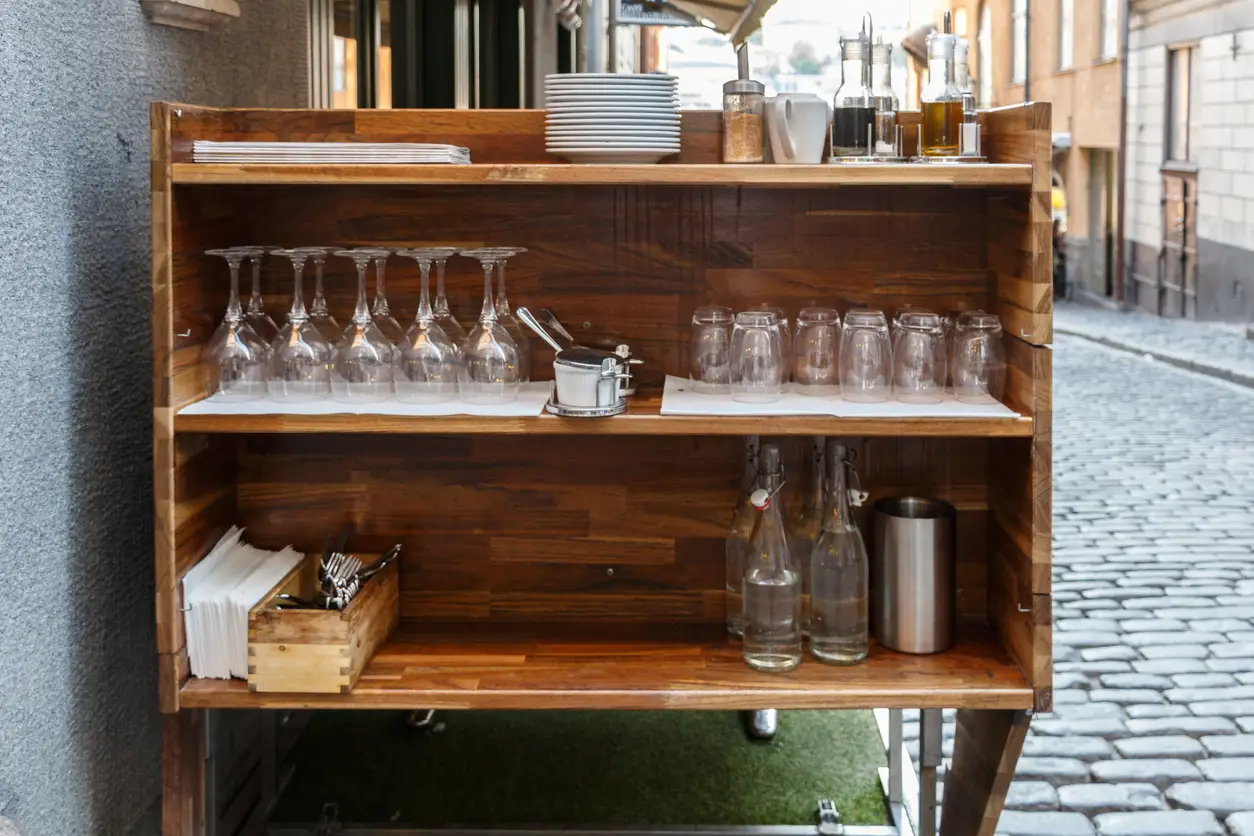
A restaurant servant is a piece of furniture, not a job title. It is a low cabinet placed on the dining floor, holding the things staff need between the kitchen and the guest.
Cutlery, napkins, side plates, condiments, menus and a bin for used linen all live inside one. Larger versions carry a coffee machine, a plate warmer or a point-of-sale terminal.
Our own range of waiter stations and servants runs from a two-drawer unit for a small bistro up to a powered station for a hotel dining room.
Where the Word Comes From
French gave the word to most of Europe. A servante in French service is a side table or cabinet that holds what a waiter needs, and the term travelled into Turkish as servant.
Turkish contract manufacturers then kept it. Consequently the word appears on Turkish price lists, in factory drawings and in export invoices, while English-speaking buyers read it as a person.
What a Restaurant Servant Is Not
It is not a member of staff, and no reputable Turkish supplier means one. It is also not a dumbwaiter, which is a small goods lift between floors and a genuinely different product.
Furthermore it is not a buffet counter. A buffet faces guests and displays food, whereas a servant faces the service side and hides everything working.
| Term | Where you see it | What it usually means | Risk of confusion |
|---|---|---|---|
| Servant | Turkey, some EU catalogues | Compact service cabinet | High in English |
| Servante | France, Belgium | Serving table or cabinet | Low |
| Waiter station | UK, Ireland, export English | Same unit, any size | Low |
| Service station | UK, hotels | Same unit | Fuel station in casual use |
| Server station | United States, Canada | Same unit | Computer server |
| Sideboard | UK, older trade usage | Lower unit, doors not drawers | Domestic furniture |
| Dumbwaiter | UK and US | Small goods lift | Very high |
| Guéridon | Fine dining, worldwide | Mobile trolley for tableside work | Medium |
Turkish Catalogue Terms and What They Mean
Turkish contract catalogues use a small set of words consistently. Learning five of them makes a price list readable in about a minute.
Servant, Servis Dolabı and Garson Ünitesi
Servant is the everyday trade word, and it usually describes a compact unit with two or three drawers. Servis dolabı translates literally as service cabinet and means the same object, often a larger one with doors.
Garson ünitesi means waiter unit and appears in newer catalogues aimed at export. Since all three describe the same product family, treat them as interchangeable and ask for the drawing.
Büfe, Konsol and Sehpa
Büfe means buffet and points at a guest-facing display unit rather than a service one. Ordering a büfe when you wanted a restaurant servant produces a handsome cabinet with no working drawers.
Konsol is a console: shallow, decorative and usually against a wall. Sehpa means a small side or coffee table, which is a different product again.
The Bathroom Servant Problem
Turkish also uses servant for a bathroom washbasin unit. So a plain web search for the word returns vanity units alongside restaurant furniture, which surprises buyers who expected one meaning.
Adding a second word solves it. Search or write restoran servantı or garson servantı and the results narrow to contract furniture immediately.
Words That Describe the Build
Ahşap means timber, metal means metal, and laminat means laminate. Çekmece is a drawer and kapak is a door, so a listing reading three çekmece and two kapak tells you the internal layout without a drawing.
Suffixes That Change the Word
Turkish adds endings rather than separate words, which is why a search can miss results. Servant becomes servantı when it belongs to something and servantlar in the plural.
So a catalogue heading may read restoran servantları rather than the bare noun. Search both forms, since suppliers index their pages inconsistently.
The same applies to the other terms. Servis dolabı becomes servis dolapları, and a listing page will usually use the plural.
European and British Equivalents
British and continental practice settled on different words for the same object. None of them is more correct, although one of them is dangerous.
Service Station and Waiter Station
These two are the standard export-English terms, and most international suppliers understand both. A waiter station is the phrase we use across our own documentation for exactly that reason.
Our guide to the restaurant waiter station covers the sizes, placement and internal layout in detail. This page stays on the vocabulary, so use the two together when you write an enquiry.
Sideboard, Credenza and Buffet
A sideboard is the older British restaurant term and usually implies doors rather than drawers. It carries domestic associations, which is why contract specifications have largely dropped it.
Credenza arrived from office furniture and now appears in hotel specifications for a low storage unit. Buffet, as noted, faces the guest and belongs to a different part of the room.
Guéridon and Trolley
A guéridon is mobile rather than fixed, and fine dining uses it for tableside carving, flambé work and dessert service. It complements a restaurant servant instead of replacing one.
Trolleys follow the same logic. Both move to the guest, while the servant stays in position and feeds the section.
Dumbwaiter: Two Different Objects
This is the word that causes real damage. In British and American usage a dumbwaiter is a small lift that moves food between floors, and it is installed by a lift contractor.
In some older texts the same word described a tiered serving stand. Therefore never use it in a furniture enquiry, because the two readings are far apart in both price and trade.
The Same Object in Other European Languages
Export projects rarely stay in one language, and a restaurant servant changes name at every border. These are the words you will meet most often, and the pattern behind them is easier to remember than the list.
Italian, Spanish and Portuguese
Italian uses mobile di servizio for the unit and carrello for the trolley. Credenza, now common in English, is an Italian word that originally described exactly this kind of serving cabinet.
Spanish and Portuguese both use aparador for a sideboard. Avoid estación de servicio in Spanish, since it means a petrol station to almost every reader.
German, Dutch and Scandinavian
German uses Anrichte for a serving sideboard and Servierwagen for a trolley. Dutch specifications commonly say dressoir, and Swedish uses skänk for the same family of furniture.
All of them imply doors and shelves rather than drawer stacks. Consequently the internal layout line matters even more in these markets.
The Russian Parallel
Russian took the same French root and produced servant as well, normally describing a glazed cabinet for dishes. The parallel is useful, because it shows how one French serving table became a different object in every language it travelled to.
That is the pattern worth remembering. Each language kept the word and adjusted the product, so the noun tells you the family and never the specification.
The word on the order form decides what arrives on the pallet
Order twelve units described only as sideboards, expecting drawer stacks for cutlery, and what arrives can be entirely correct against the word: twelve low cabinets with doors and a single internal shelf. Every cover then gets reset from a trolley until replacements arrive. Nobody has made a production mistake in that situation, and nobody has written a specification either. Because the words differ by market, an enquiry that names only the product type is not a specification at all. Name the drawers, the doors, the worktop and the intended contents, and the label stops mattering.
One ambiguous word → twelve cabinets that could not hold cutlery
North American Usage
American operators use a third set of words for a restaurant servant, and two of them carry their own ambiguity.
Server Station and Bus Station
Server station is the common term, and it means precisely what a restaurant servant means. Bus station, in American restaurant usage, is the unit where dirty plates and glassware are collected.
The two are often separate pieces of furniture in a large room. Consequently a North American drawing may show both, and a European drawing may combine them into one unit.
Expo, Pass and Service Counter
Expo and pass describe the kitchen side rather than the floor. Neither is a restaurant servant, although suppliers occasionally quote a stainless kitchen unit when they read the word.
Service counter is the safest neutral phrase in North American English. It also travels well into Spanish-language specifications, where estación de servicio otherwise reads as a petrol station.
How to Write the Specification Instead
The reliable fix is to stop relying on the noun. A supplier in any country can quote a restaurant servant accurately from a description of function and contents.
Describe the Function, Not the Name
Write what the unit does before you write what it is called. A sentence such as a floor-standing service unit holding cutlery for sixty covers removes every ambiguity in this article at once.
Then add the working details. Whether staff approach it from one side or two, whether it needs power, and whether it must lock overnight all change the build.
The Six Lines That Remove All Doubt
Six lines cover almost every case, and they fit into an email. Send them with any enquiry, whatever word your supplier uses on their price list.
| # | Line to write | Why it removes ambiguity |
|---|---|---|
| 1 | Function: service unit for the dining floor | Rules out buffet, console and kitchen pass |
| 2 | Contents: cutlery, napkins, side plates, menus | Forces drawers rather than a single shelf |
| 3 | Internal layout: three drawers, two doors | The line most often left out |
| 4 | Worktop: material, thickness and edge | Decides how it survives service |
| 5 | Power: sockets, cable route, appliance load | Separates a plain unit from a powered one |
| 6 | Access: one side or two, lockable or open | Changes the carcass, not the finish |
Photographs, Drawings and Codes
Words fail; pictures rarely do. Ask for a photograph of a completed unit, a dimensioned drawing and the supplier’s own product code with every quotation.
Then quote the code back in the purchase order. A code identifies one product in one factory, which no noun in any language manages to do.
Keep the same three items in your project file. When a contractor asks what goes in a position on the drawing, the photograph answers faster than a specification does.
Servants, waiter stations, service cabinets
Whatever your drawing calls it, we build the unit: timber and laminate carcasses, drawer stacks, lockable doors and worktops made for service.
Reading a Turkish Supplier’s Catalogue
Once the vocabulary is clear, a Turkish price list becomes straightforward. Our guide to Turkish restaurant furniture covers why buyers end up reading one in the first place. Three conventions explain most of what looks unfamiliar on a restaurant servant listing.
How Product Names Are Built
Names usually run material first, then product, then a code. So a line reading ahşap servant 03 is simply the third timber service cabinet in the range.
Codes rarely mean anything outside the factory. Therefore quote the code back in your order, since it is the fastest way for the supplier to identify the exact unit.
How Dimensions Are Written
Turkish listings give width, depth and height in that order, usually in centimetres and often without labels. A line reading 120 × 45 × 90 therefore means 120 wide, 45 deep and 90 high.
Compare that against the working sizes in our waiter station guide before you accept a figure. Depth in particular is the dimension buyers under-specify most often.
Material Words Worth Knowing
Beyond timber and laminate, two words appear constantly. Suntalam means melamine-faced chipboard, and MDF lam means laminated MDF, which matters because the two behave differently around water.
Worktops follow the same vocabulary as tables. A compact laminate top survives a service station better than most alternatives, while a solid timber top looks warmer and needs a harder lacquer.
Our comparison of restaurant table tops and bases explains how those cores perform in service. The same logic applies to a servant worktop, only with more spillage.
Why the Terminology Costs Money
Vocabulary looks like a soft problem until an invoice arrives. Three situations turn it into a hard one.
Quotation Errors
A supplier quoting the wrong product type produces a price that cannot be compared with anything. Buyers then choose the cheapest line without noticing that it holds nothing.
Ask for a photograph of a completed unit alongside every quotation. Photographs cross language barriers that words do not.
Customs and Shipping Descriptions
Export paperwork needs a product description that a customs officer recognises. Restaurant servant means nothing in that context, whereas wooden service cabinet or restaurant furniture is standard.
Agree the wording with your supplier before shipment. A description mismatch between the invoice and the packing list delays clearance far more often than the goods themselves do.
Fit-Out Drawings and Site Confusion
Contractors work from drawings rather than catalogues. A unit labelled with an unfamiliar word gets placed wherever there is room, which is rarely where the section needs it.
Label the drawing with the function and the section it serves. Our guide to restaurant table spacing covers how those service positions relate to the tables around them.
A translation problem is cheaper to fix before the deposit
Correcting a misunderstood specification before production costs an email. Correcting it after delivery costs the unit, the freight in both directions and the weeks of trading in between, and on made-to-order joinery it usually costs the whole item because there is no resale value in a bespoke cabinet built to the wrong internal layout. Six lines of description at enquiry stage remove that risk entirely, which makes this the highest-return five minutes in a furniture order.
Six lines at enquiry → no bespoke unit written off after deliveryA Short Glossary
Keep this beside any catalogue you are reading. It covers the words that appear most often around a restaurant servant in Turkish and European contract furniture listings.
| Turkish | English | Notes |
|---|---|---|
| Servant | Waiter station, service cabinet | Also a bathroom vanity unit |
| Servis dolabı | Service cabinet | Usually the larger version |
| Garson ünitesi | Waiter unit | Newer export term |
| Büfe | Buffet | Guest-facing, not service |
| Konsol | Console | Shallow and decorative |
| Sehpa | Side or coffee table | Different product |
| Çekmece | Drawer | Count these in the listing |
| Kapak | Door | Doors imply shelves |
| Ahşap | Timber | Solid or veneered |
| Suntalam | Melamine-faced chipboard | Watch the edges near water |
| Tezgah | Worktop or counter | Also used for bar counters |
| Kilitli | Lockable | Ask for it explicitly |
Mistakes Buyers Make With the Word
Every one of these appears regularly in restaurant servant enquiries, and every one is avoidable.
Assuming It Means a Person
Some buyers quietly discard a Turkish quotation because a line item looks like staffing. The line is furniture, and asking one question recovers a competitive price.
Treating Servant and Sideboard as Identical
They overlap without matching. A sideboard usually means doors and shelves, so a cutlery-heavy operation ends up resetting covers from a trolley.
Searching Without a Qualifier
A bare search for the word returns bathroom units in Turkish and domestic staffing pages in English. Two words instead of one fixes the search completely.
Letting the Contractor Name It
Whoever writes the drawing label decides what gets ordered. Set the vocabulary once at the start of a project, then use it in every document.
Forgetting the Rest of the Room
Service furniture gets specified last and squeezed into whatever space remains. Our overview of what furniture a restaurant needs puts it back in the schedule where it belongs.
Order it with the rest. Specifying the service units alongside your restaurant chairs and tables keeps the finishes matched and puts everything on one production run.
FAQ
What is a servant in a restaurant?
A restaurant servant is a service cabinet on the dining floor that staff work from, holding cutlery, napkins, plates, menus and sometimes a coffee machine. It is furniture rather than a person, and English-language catalogues call the same unit a waiter station or service station.
Why do Turkish catalogues use the word servant?
The term reaches Turkish from the French servante, meaning a serving table or cabinet. Turkish contract manufacturers kept the word, so it appears on price lists, drawings and export documents.
Is a restaurant servant the same as a waiter station?
In practice, yes. A servant usually describes a compact unit with two or three drawers, while waiter station covers the whole family including larger and powered units.
Is a servant the same as a dumbwaiter?
No, and the difference matters. A dumbwaiter is a small lift that moves food between floors, installed by a lift contractor rather than a furniture maker.
What is the difference between a servant and a sideboard?
A restaurant servant is built around drawers for cutlery and linen, while a sideboard traditionally means a lower cabinet with doors and shelves. Specify the internal layout rather than relying on either word.
How do I search a Turkish catalogue for one?
Use two words rather than one, such as restoran servantı or garson servantı. A single-word search returns bathroom vanity units, which share the same Turkish name.
What should I write in an enquiry?
Describe the function, the contents, the internal layout, the worktop, the power requirement and the access. Six lines of description let any supplier in any language quote the same product, whatever they call it.
Who makes them?
Contract furniture factories build them to order alongside seating and tables. Our guide to restaurant furniture manufacturers covers how to audit a supplier before placing that kind of work.
More in this category