
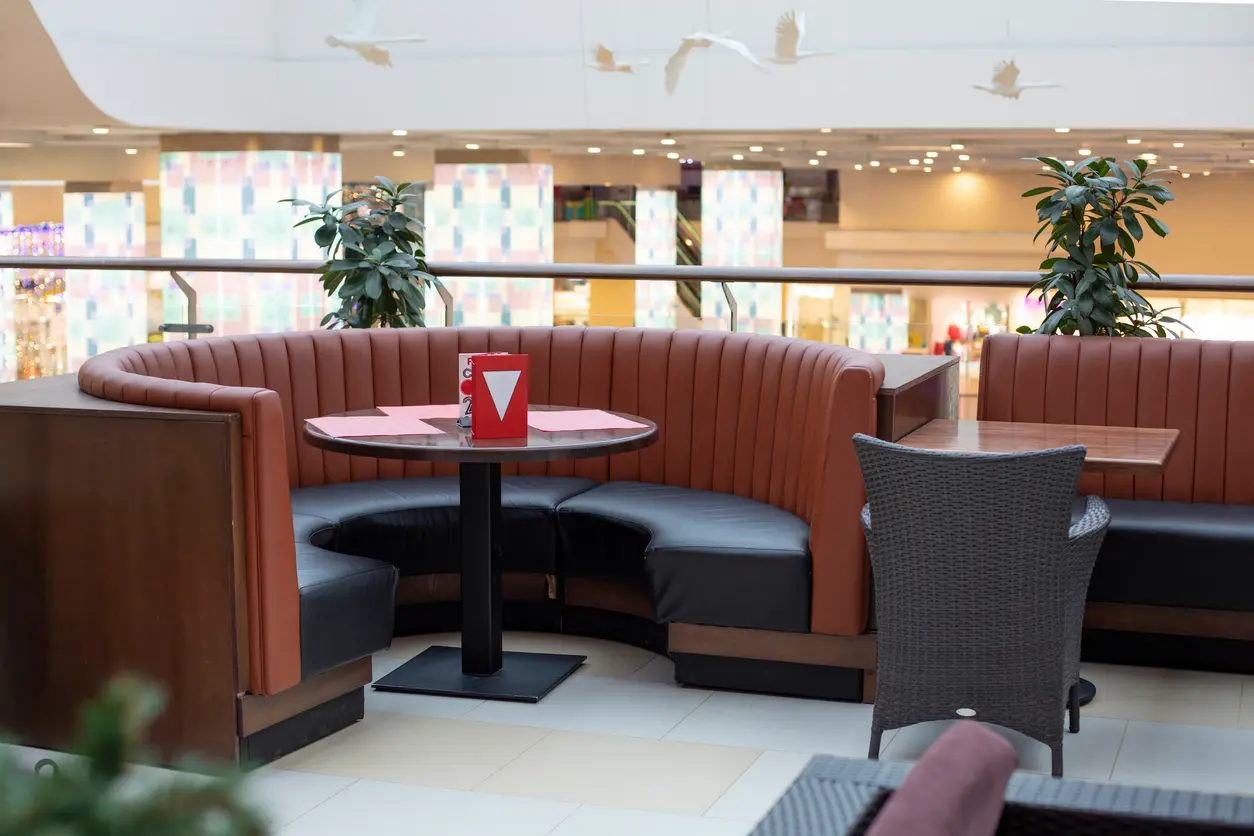
Corner booth seating costs more per metre than any other fixed seating you can buy. It also rescues floor area that no straight run and no loose table will ever use. Whether it earns the premium depends entirely on which corner it sits in and how many covers that corner returns.
This guide covers the shapes, the geometry that makes a curve work, why curved joinery costs what it does, and the specific situations where the money comes back. It assumes you have already chosen fixed seating over loose chairs.
Corner booth seating earns its cost in three places: a dead internal corner that straight seating cannot use, a window bay or column pocket with an awkward angle, and a room that turns away large parties. Expect a curved or corner unit to cost 40 to 80 percent more per seat than a straight booth, because the workshop makes the frame, the foam and the upholstery once rather than repeating them. Everywhere else, a straight run with a return is the better buy.
Contents
- What Counts as Corner Booth Seating
- Where Corner Booth Seating Earns Its Cost
- Radius, Depth and Usable Seat Length
- Why Corner Booth Seating Costs More
- The Table Inside the Curve
- Access, Service and the Middle Seat
- Specifying a Curved Booth Properly
- Upholstery and Wear on a Curve
- Where Corner Booths Do Not Pay
- Corner Booth Seating Mistakes That Waste the Premium
- FAQ
What Counts as Corner Booth Seating
The term corner booth seating covers four different products at four very different prices. Naming the one you mean is the first step, because suppliers quote them separately.
The L-Shaped Corner Booth
Two straight runs meeting at ninety degrees, with a filled internal corner. This is the cheapest form of corner booth seating, since both arms are ordinary straight joinery and only the junction is bespoke.
It suits a real building corner. The seat continues around the angle, and a rectangular or square table sits against the intersection.
The Quarter-Round
Here the internal corner becomes a curve rather than a right angle. A quarter-round softens the junction, seats one or two more guests than a hard corner, and costs noticeably more to build.
The curve also solves a comfort problem. Nobody wants the seat directly in a ninety-degree corner, because there is nowhere to put a shoulder.
The Half-Round Booth
A half-round, sometimes called a semicircular or crescent booth, is a single curved unit open on one side. It seats six to eight and is the classic solution for a group table.
Half-rounds work against a flat wall as well as in a corner. Consequently they suit window bays, alcoves and the blunt end of a long room.
The Full U and the Circular Booth
A U-shape wraps three sides of a table, while a full circular booth encloses it almost entirely with a single entry gap. Both seat eight or more and both are the most expensive form of fixed seating in normal use.
They also make a room feel designed. That is a real commercial benefit in a venue where the seating itself sells the booking.
| Shape | Typical covers | Footprint | Best position | Relative cost per seat |
|---|---|---|---|---|
| Straight booth | 4 | 1.2 × 2.0 m | Along a wall | 1.0 |
| L-shaped corner | 5–6 | 2.0 × 2.0 m | Building corner | 1.2 |
| Quarter-round | 5–7 | 2.2 × 2.2 m | Softened corner | 1.5 |
| Half-round | 6–8 | 2.4 m diameter | Bay, alcove, end wall | 1.6 |
| U-shape | 8–10 | 2.6 × 2.2 m | Private corner | 1.7 |
| Circular | 8–12 | 2.8 m diameter | Centre floor, feature | 1.8 |
Where Corner Booth Seating Earns Its Cost
A curved unit is worth the premium in a small number of situations. Outside them the same money buys more covers elsewhere in the room.
Dead Corners and Awkward Angles
Every dining room has a corner that nothing fits. Two loose tables meeting at an angle leave a triangle of floor that no guest can occupy and no server can cross.
Corner booth seating turns that triangle into seats. Since the corner had no commercial value before, every cover it produces is genuinely new rather than moved from elsewhere.
Run the arithmetic before committing. A corner that yields four extra covers at two turns a night pays back joinery quickly, whereas one that yields two rarely does.
Window Bays and Column Pockets
Bays and columns create the same problem in a different shape. A curved unit follows the geometry of a bay instead of fighting it, and a quarter-round tucks neatly into the pocket a column leaves behind.
Window seats also sell. Guests ask for them, so a bay booth carries a higher acceptance rate than a table of the same size in the middle of the floor.
The Group Table Problem
Most rooms handle two and four well and handle eight badly. Pushing four tables together blocks an aisle, takes staff time and looks improvised.
One half-round solves that permanently. It also holds smaller parties without looking empty, which a long pushed-together run never manages.
Rooms Where Seating Sells the Booking
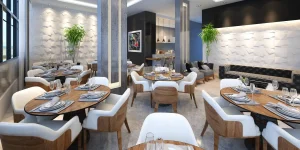
In hotels, private dining and destination restaurants, corner booth seating is part of what guests pay for.
A curved booth photographs well, and guests request it by name. That value is real but hard to measure. So treat it as a reason to choose curved seating rather than as a justification on its own.
Radius, Depth and Usable Seat Length
Corner booth seating behaves differently from a straight run, and the difference is not intuitive. Two units with the same seat length can seat very different numbers of guests.
Inside Radius and Usable Seat
Measure seats along the front edge of the cushion rather than along the back. On an inside curve the front edge is shorter than the back, so a unit that looks generous on plan can seat fewer people than expected.
Allow 60 cm of front-edge length per guest, exactly as you would on a straight bench. Then check that figure at the tightest part of the curve rather than as an average.
Radii below about 90 cm start to pinch. Below 70 cm the guests at the ends of the curve face each other rather than the table.
Seat Depth on a Curve
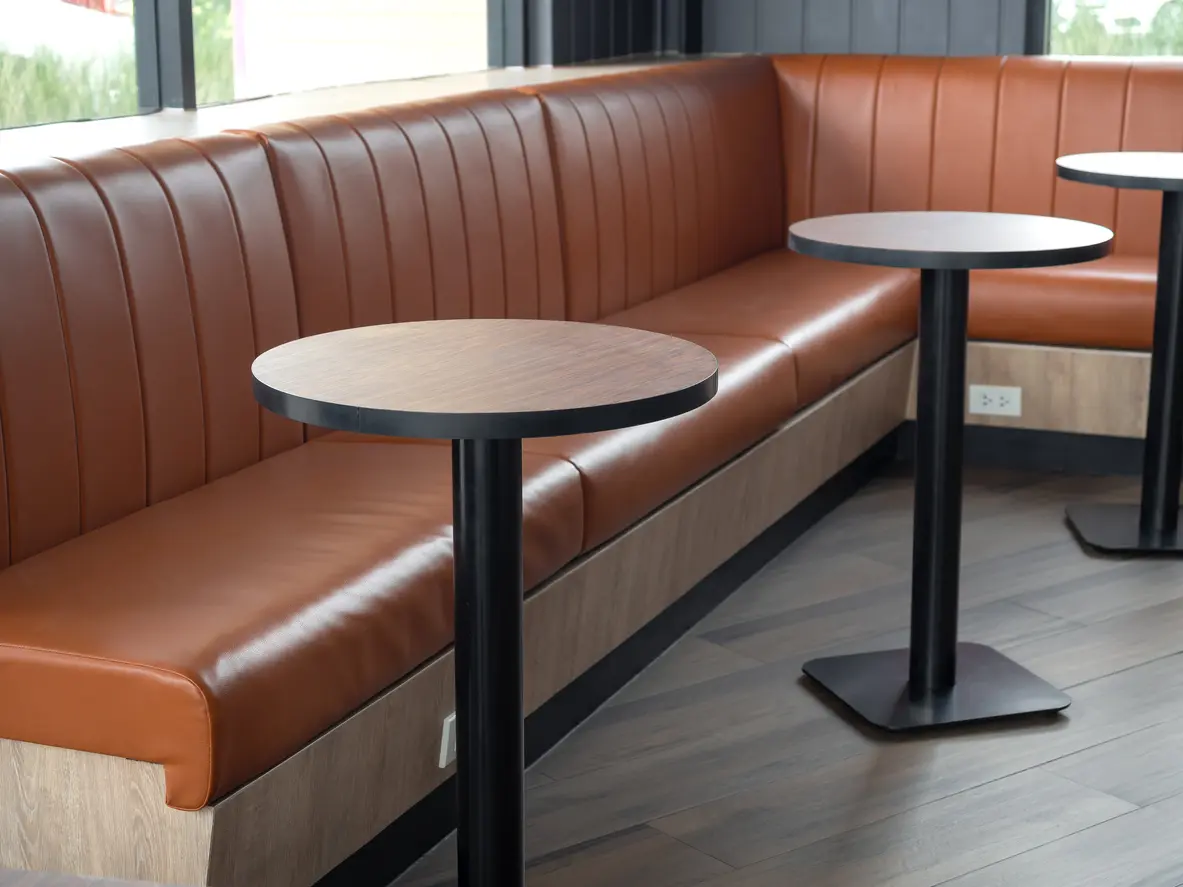
Standard booth seat depth of 45 to 50 cm still applies, measured on a line running to the centre of the curve. Depth taken square to the wall gives a false reading and produces a seat that is too shallow at the corners.
Back angle matters more here as well. A back raked at five to ten degrees is comfortable on a straight run and can feel cramped on a tight radius, since the rake eats forward space where the curve is already tight.
Height, Back and Privacy
Booth back height is a privacy decision rather than a comfort one. Our comparison of booths and banquettes covers the general dimensions, and the same figures carry over to a curve.
One difference is worth noting. A tall back on a tight radius creates a bowl that traps sound and heat, so drop the back height slightly on any unit under a 1.2 m radius.
Why Corner Booth Seating Costs More
The premium on corner booth seating is not a supplier margin. It comes from three separate places in the workshop, and knowing them tells you where a quotation can move.
Frame and Substrate
A saw cuts a straight booth frame directly from sheet. A curved one needs kerfed or laminated substrate, a former to hold the shape while the glue cures, and hand-fitting at every junction.
That is bench time rather than machine time, and bench time is the expensive kind. Consequently the frame alone can account for half of the premium.
Upholstery on a Curve
Foam on a curve needs cutting in segments, then dressing so the joints disappear. Easing fabric around the radius without puckering then takes an experienced upholsterer rather than a fast one.
Patterned and striped coverings multiply the problem. A stripe that runs true on a straight back fans visibly on a curve, so plain or small-scale coverings are the sensible choice.
No Repeat Units
The real cost driver is that nothing repeats. Ten identical straight booths share one set-up, one cutting list and one pattern, while every curved unit is a separate job from drawing to delivery.
So order curved units in matched pairs where the plan allows. Two mirrored quarter-rounds cost noticeably less than two unrelated ones.
Judge a corner unit on covers gained, not on price per metre
Corner booth seating almost always loses a price-per-metre comparison against straight joinery, and that comparison is the wrong one. The question is how many covers the corner produced before, and how many it produces afterwards. A dead corner that yields five new covers, turning twice a night, six nights a week, adds roughly three thousand covers a year that the room could not previously sell. Against that number a joinery premium of a few thousand pays back inside the first season. Apply the same test in reverse: a curved unit that merely replaces seats you already had is decoration, so price it as decoration.
5 new covers → about 3,000 additional covers a yearThe Table Inside the Curve
Half the complaints about corner booth seating are really complaints about the table. Getting the top and the base right is what makes the unit work.
Shape of the Top
A round top suits a half-round booth, and a D-shaped top suits a unit that meets a wall. Square tops in a curve leave two corners jammed into the upholstery and two guests reaching.
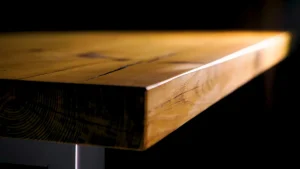
Surface choice matters more here than on a loose table, because staff cannot lift the top to clean under it. A compact laminate top shrugs off the wiping a booth needs, while a solid timber top looks warmer and asks for a harder lacquer.
Our comparison of round, square and rectangular restaurant tables covers how shape changes covers in the room generally. Inside a curve, round almost always wins.
Base and Knee Space
Guests slide in sideways, so their legs travel across the base rather than around it. A single central column with a small foot is therefore the only practical choice.
Cross feet and four-leg bases both fail here. They catch shins during entry and they stop the last guest reaching the far side.
Our table bases and legs list the maximum top size each column carries, which matters because a large round in a booth still needs a base that will not tip. The full restaurant table range carries the matching tops.
Distance From Seat Front to Table Edge
Allow 15 to 20 cm between the front of the cushion and the table edge. Tighter than that and guests cannot slide in, while looser than 25 cm leaves them reaching for the plate.
Check the figure at the middle of the curve as well as at the ends. On a tight radius those two positions differ by more than people expect.
Access, Service and the Middle Seat
Corner booth seating changes how guests get in and how staff work the table. Think both through before you order the unit.
Getting In and Out
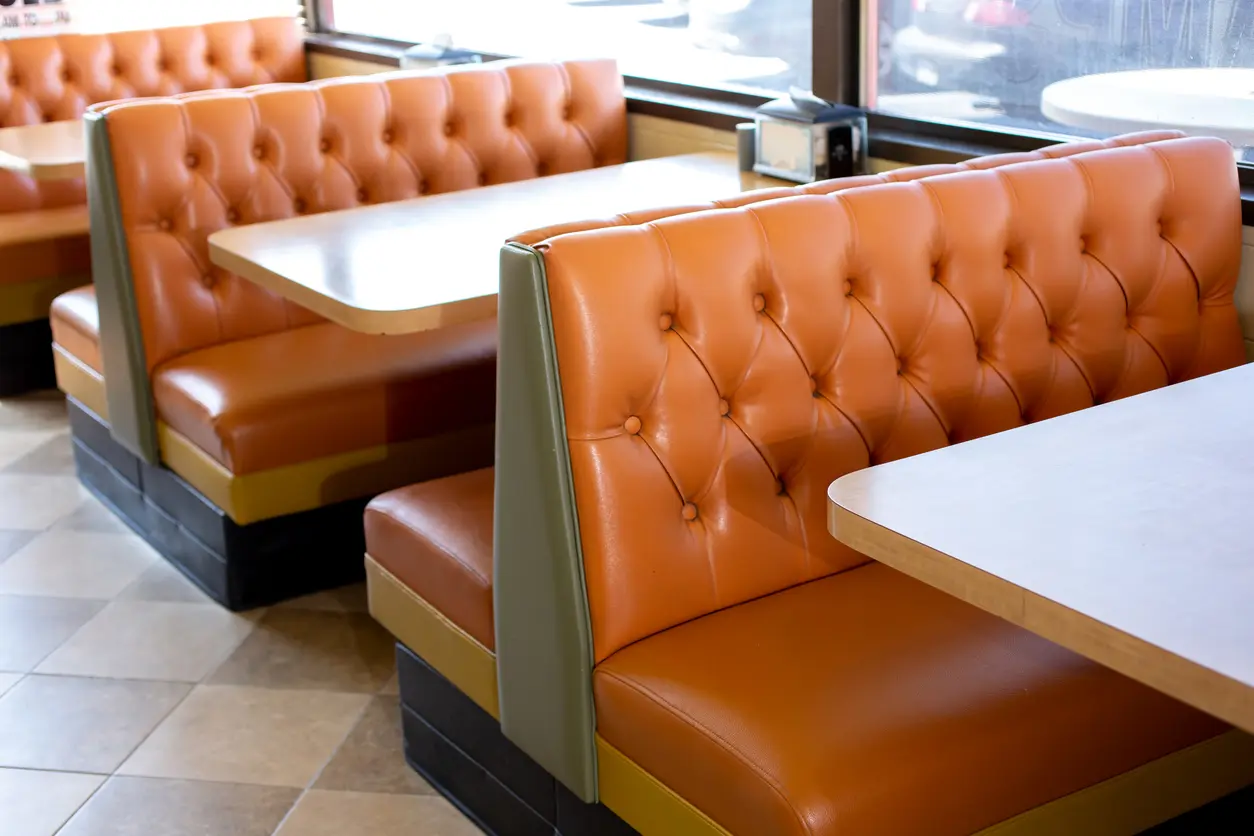
Everyone slides. On a U-shape or a circular booth, three other guests seal in the one in the middle. That suits a long dinner and frustrates a family with young children.
A half-round is the compromise. It gives the enclosed feeling without trapping anybody more than one seat deep.
Serving a Curve
Servers can only reach the front. A table wider than about 110 cm inside a booth puts the far side out of reach, which means either leaning across guests or moving plates by hand along the table.
Keep the top within reach and brief the team on a serving side. Our guide to restaurant table spacing covers the aisle widths that let a server work a booth without blocking the room.
Accessibility
Fixed seating never moves, so a wheelchair user cannot use a booth in the ordinary way. Provide accessible positions elsewhere in the room, and count them properly against local requirements.
An open end helps. A half-round with one square end can take a loose chair, which turns the unit into a usable accessible position without redesigning it.
Booths and banquettes built to your floor plan
Straight runs, L-shaped corners, quarter-rounds and half-round units, upholstered in contract coverings and made to your site dimensions.
Specifying a Curved Booth Properly
No catalogue line covers a curved unit. The maker works from your drawing, so the drawing carries the risk.
What the Drawing Must Show
Plan, elevation and a section through the seat are the minimum. Add the internal radius, the front-edge seat length, the seat depth measured to the centre of the curve, and the finished height of both seat and back.
Mark the table position and the base footprint on the same plan. That single overlay catches most of the conflicts that would otherwise appear on site.
Templates and Site Survey
Survey the site rather than trusting the architect’s plan. Our step-by-step booth seating floor plan guide sets out that survey in order. Walls are rarely square, and a curved unit built to a drawing that assumes ninety degrees will not sit against a wall that is out by two.
For anything above a 1.5 m radius, ask for a template. A sheet template on the floor costs almost nothing and settles the fit before anyone cuts material.
Tolerances and Site Fixing
Agree a scribe allowance in writing, usually 15 to 25 mm on any face meeting a wall. Without it, a unit made exactly to dimension arrives too big for the opening.
Curved units also need to enter the building. Check door widths, stair turns and lift dimensions before approving a single-piece unit, since splitting it afterwards spoils the upholstery line.
Our guide to what to check before ordering covers the same specification discipline for made-to-order tables, and every point carries over to joinery.
Upholstery and Wear on a Curve
Corner booth seating wears differently from a straight bench. The pattern follows the way guests move rather than where they sit.
Entry Points Take the Damage
Guests slide in at the open ends, so the front corners of the seat absorb most of the abrasion. Specify a heavier rub count at those positions, or design a removable end panel the upholsterer can recover on its own.
Piping along the front edge helps as well. It takes the friction that would otherwise attack the seam.
Seams on the Radius
Seams that run around a curve are under constant tension. Double-stitch them, and ask the maker to run the seam at the crown of the curve rather than on the tightest part.
Fluted and buttoned backs look excellent on a curve and cost more to keep clean. Our notes on cleaning restaurant furniture cover which coverings survive a nightly wipe.
Planning for Recovering
Fixed seating goes back to the upholsterer rather than to the skip, usually every five to seven years. Ask at the order stage whether the seat and back panels lift out, because recovering a unit in place doubles the labour and closes that section of the room for longer.
Where Corner Booths Do Not Pay
The premium on corner booth seating is real, so it deserves an honest test. In these situations the answer is usually no.
High-Turnover Rooms
Fast casual and quick service depend on resetting tables in seconds. Corner booth seating slows entry and exit, and nobody can reconfigure it when the party mix changes.
Small Rooms With Straight Walls
If the room is a simple rectangle, straight runs use it more efficiently. Corner booth seating adds cost without unlocking any floor that a straight bench could not already reach.
When a Return Does the Same Job
A straight banquette with a short return often produces the same covers for a fraction of the price. Test that option first, because it wins more often than designers expect.
Loose seating deserves the same test. A pair of restaurant chairs against a wall run costs a fraction of curved joinery and moves whenever the party mix changes.
Tight Budgets
Where the budget is the constraint, spend it on covers rather than on shape. Our notes on low-budget restaurant design cover the sequence that gets a room open without overspending on joinery.
A curved booth locks your party mix for a decade
Staff recombine loose tables every service. A half-round seating eight cannot become two tables for four, so on any night when large parties do not arrive, the unit seats two people in a footprint that could have held six. In a room with a booking profile weighted towards couples this is a permanent drag on covers, and correcting it means removing the joinery. Check twelve months of booking data for party size before committing to any unit above six covers, and treat a single half-round as the safe maximum in a room that has never demonstrated group demand.
One 8-seat unit → two guests in a six-cover footprintCorner Booth Seating Mistakes That Waste the Premium
You settle every one of these on paper, and every one costs nothing to avoid.
A Square Table in a Round Booth
The corners jam into the upholstery and two guests end up reaching. Use a round or D-shaped top, and match the diameter to the curve rather than to a stock size.
Measuring the Seat Along the Back
Guests sit on the front edge. Measuring capacity along the back rail overstates the covers by one or two on almost every curved unit.
A Four-Leg Table Base
Legs catch shins during entry. A central column with a compact foot is the only base that lets guests slide the full width.
Ordering Before the Site Survey
Walls are not square and floors are not level. A curved unit made to a nominal drawing arrives with a visible gap, and scribing a curve is far harder than scribing a straight run.
Patterned Fabric on a Tight Radius
Stripes and geometrics fan on a curve. Choose plain or fine-textured coverings, and keep the pattern for the loose chairs instead.
FAQ
How many people does corner booth seating hold?
An L-shaped corner takes five or six, a quarter-round five to seven, a half-round six to eight, and a U-shape or circular unit eight or more. Count 60 cm of front-edge cushion per guest measured at the tightest part of the curve.
How much more does a curved booth cost than a straight one?
Expect 40 to 80 percent more per seat for the same specification. The premium comes from laminated or kerfed framing, segmented foam and hand-fitted upholstery, none of which repeats across units.
What size table fits a half-round booth?
A round top of 110 to 130 cm suits a 2.4 m half-round seating six to eight. Keep the top within about 110 cm where servers must reach the far side without leaning across guests.
What radius works for a curved booth?
Aim for an internal radius of at least 90 cm, and treat 1.2 m as comfortable. Below 70 cm the end guests face each other rather than the table.
Is corner booth seating worth it in a small restaurant?
Only where a genuine dead corner exists. In a simple rectangular room a straight run with a short return produces the same covers for much less money.
Can a wheelchair user sit at a booth?
Not in the ordinary way, because fixed seating cannot move. Specify a half-round with one open square end that takes a loose chair, and provide accessible positions elsewhere in the room.
Who makes curved and corner booths?
Contract upholstery workshops and furniture factories build them to your drawing rather than from a catalogue. Our guide to restaurant furniture manufacturers covers how to audit a supplier before placing that kind of made-to-order work.
More in this category