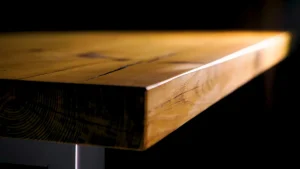

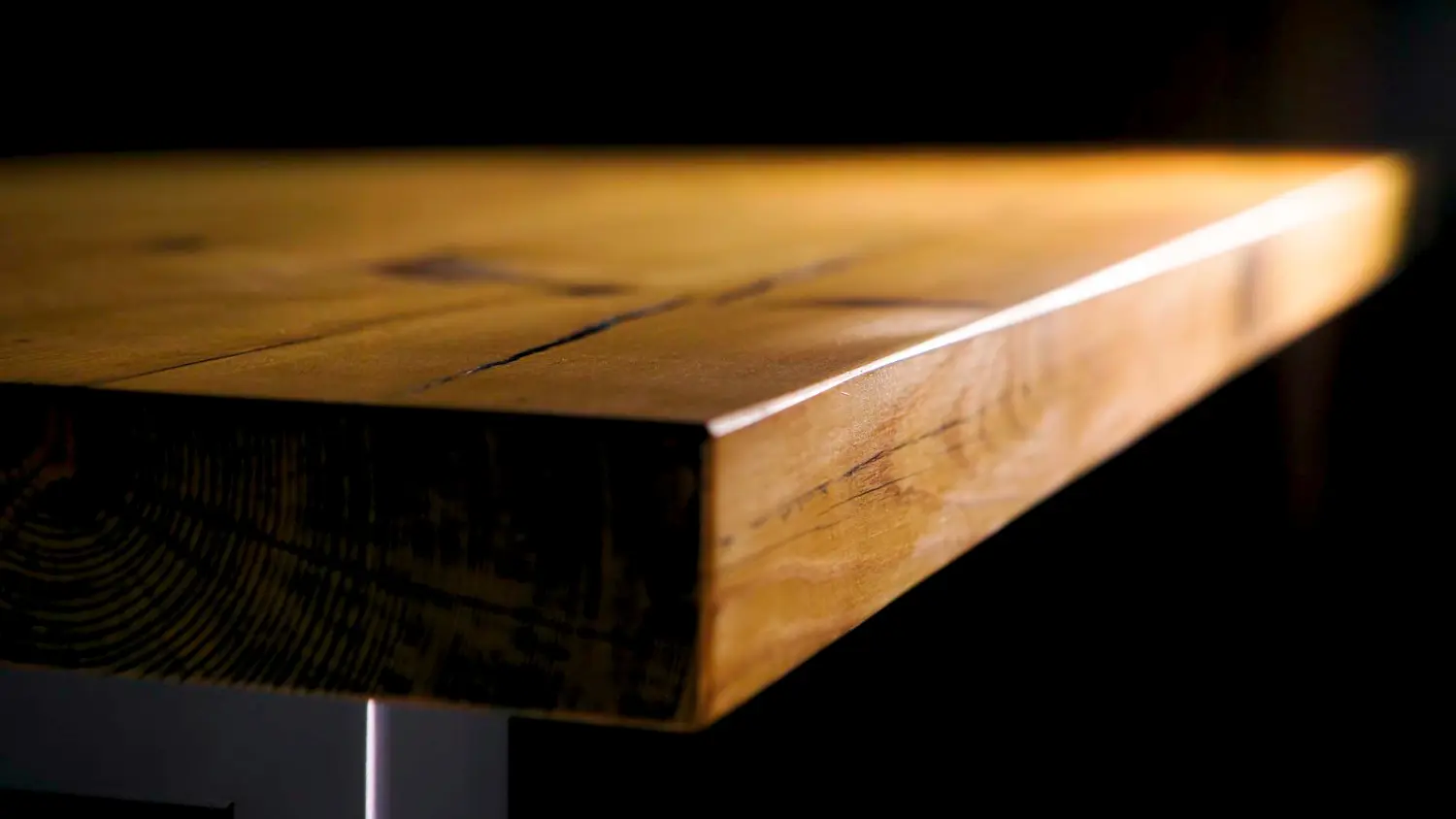
Guests touch one part of a restaurant table on purpose, and table top edge profiles decide how it feels. They rest a forearm on the edge, run a thumb along it while reading a menu, and knock a chair into it twice a service.
Nevertheless table top edge profiles are usually the last line on an order and frequently no line at all. Consequently the factory applies its default, and the room inherits a detail nobody chose.
Below, this guide sets out the named profiles and their geometry, which ones each material can actually hold, how the edge behaves against chairs, cloths and cleaning, and how to write the profile you want onto an order.
Table top edge profiles describe the shape of the outer 3 to 30 mm of a top. A square edge looks crisp and chips first; a 2 to 3 mm eased arris removes that risk almost entirely; a full bullnose is the most forgiving under chair impact; a chamfer reads as thinner than it is; and a mitred edge makes a thin top look substantial. Choose by material before appearance, because stone and veneer cannot hold a sharp arris, whereas compact laminate and solid timber can. Above all, name the profile and its radius in millimetres on the order.
Contents
- What a Table Top Edge Profile Actually Is
- The Six Table Top Edge Profiles
- Which Materials Hold Which Table Top Edge Profiles
- How Factories Build Table Top Edge Profiles
- Where Table Top Edge Profiles Get Damaged
- The Edge Guests Feel
- Combining Tops and Matching Edges
- Cleaning, Cloths and Hygiene
- Choosing Table Top Edge Profiles for Your Room
- Writing the Table Top Edge Profile Onto an Order
- Mistakes Buyers Make With Table Top Edge Profiles
- FAQ
What a Table Top Edge Profile Actually Is
A table top edge profile is the shape a factory cuts, moulds or applies around the perimeter of a top. In other words it is a cross-section, and every property that follows comes from that section.
Three Things the Section Decides
Firstly, the section decides how impact energy spreads when a chair back meets the table. A sharp corner concentrates that energy into a line, whereas a curve spreads it across an arc.
Secondly, the section decides how thick the top appears. A chamfer cuts material away from the underside, so a 30 mm top can read as 18 mm from a standing eye.
Thirdly, the section decides what a cloth can reach. Because a tight internal angle traps residue, some profiles clean in one wipe and others never quite do.
Radius, Arris and Chamfer
Three words appear on every drawing, so they are worth separating. An arris is simply the line where two surfaces meet, and an eased or broken arris means the factory has taken that line off slightly.
Meanwhile a radius describes a curve of a stated size, written as R2 or R3 for two or three millimetres. Additionally a chamfer describes a flat cut at an angle, usually 45 degrees, stated as a depth rather than a curve.
Why It Gets Left Off Orders
Most buyers specify size, thickness and finish, then stop. However the factory still has to cut an edge, so it applies whatever its tooling carries that week.
Our guide to restaurant table tops and bases covers the material decision that comes first. This page assumes you have settled that and looks only at the perimeter.
Two millimetres left off a drawing, replaced across a whole room
A square arris on a timber or veneered top looks precise on a sample and behaves badly in service. Every chair pushed in strikes the same line, and because a sharp corner has no material behind it, the first impacts crush fibres rather than absorbing anything. Within a season the front edge of every table facing the walkway shows pale bruising, and within two the veneer or lacquer has broken open. None of it is a manufacturing fault, since the factory built precisely what the order described. An eased arris of 2 mm, written as one line, removes almost the entire failure mode and changes nothing anybody notices about the look. Consequently the edge radius is the highest-value line on a table order and the one most often missing.
A missing radius line → bruised front edges across the walkway run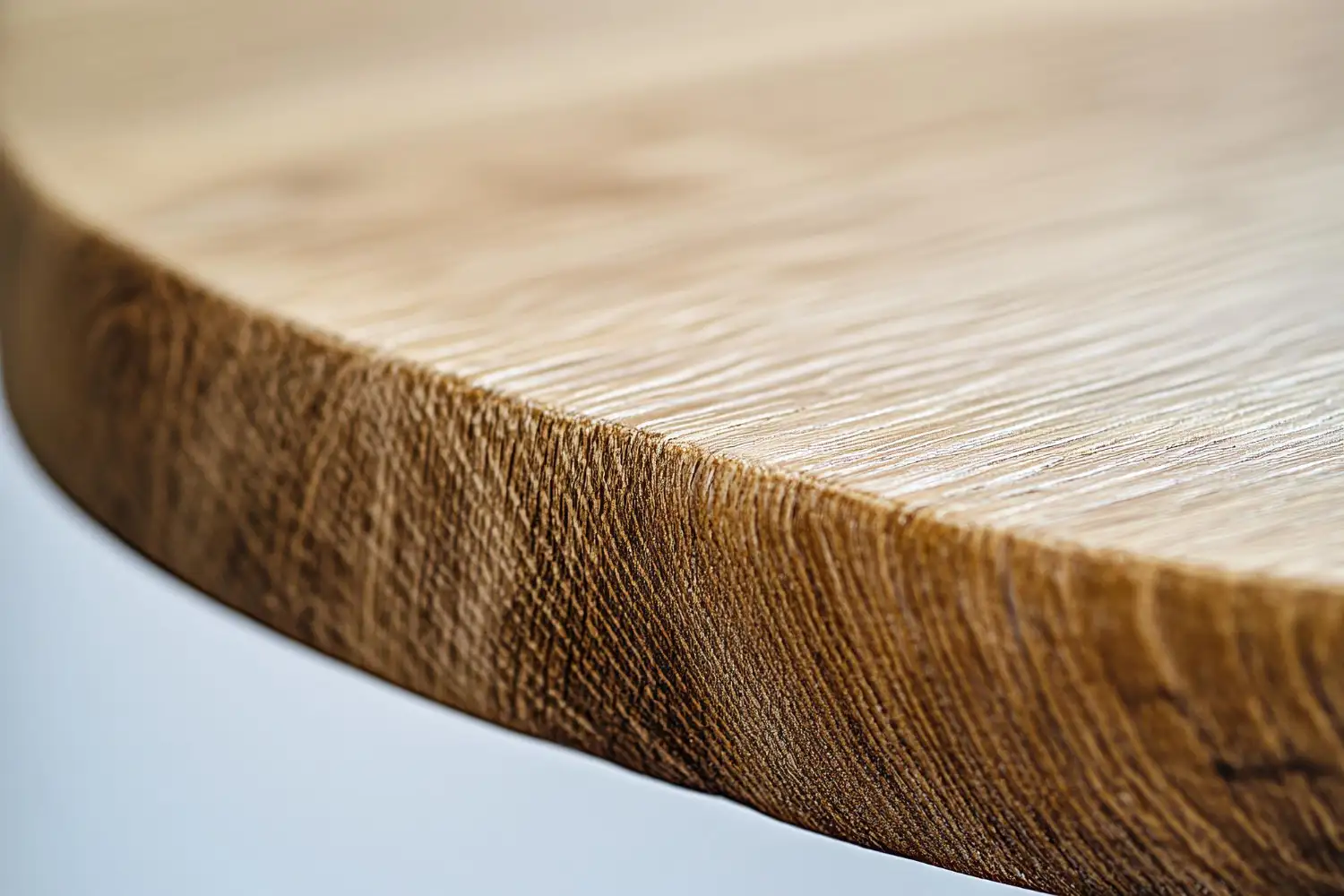
The Six Table Top Edge Profiles
Contract work uses a small vocabulary, and six table top edge profiles cover almost everything. Each carries a different balance of appearance, durability and cleanability.
Square
A square edge leaves both arrises sharp and reads as the most architectural option. However it also concentrates every impact into two lines and chips first in any material.
Notably it suits compact laminate, where the core is dense and uniform, far better than it suits veneer or stone.
Eased or Broken Arris
Here the factory takes roughly 1 to 3 mm off the top and bottom arrises, either as a tiny radius or a tiny chamfer. Consequently the edge still reads as square from a metre away and behaves far better under impact.
In practice this is the default worth asking for whenever appearance calls for a square look. Additionally it adds almost no extra work at the factory.
Radius
A stated radius, commonly R3 to R6, rounds the visible arris into a clear curve. Therefore it spreads impact well and stays easy to wipe in one pass.
Meanwhile larger radii start to soften the whole look of a room, which suits relaxed dining and works against sharper interiors.
Bullnose and Half Bullnose
A full bullnose curves the entire thickness into a half circle, whereas a half bullnose rounds the top half and leaves the underside square. Since a bullnose presents no arris at all, it survives chair impact better than any other profile.
Furthermore it is the friendliest profile against a forearm, which is why it appears so often on bar counters and high tables.
Chamfer and Bevel
A chamfer is a flat angled cut, usually running from the underside so the top appears thinner. Consequently it lets a heavy top look light, which matters most in stone and thick laminate.
Conversely a top-side chamfer creates a narrow flat that catches light and shows wear quickly. So specify which face the chamfer comes from rather than assuming.
Mitred or Waterfall
The factory cuts two panels at 45 degrees and joins them so the grain or pattern runs continuously around the corner. As a result a 20 mm top can present a 60 mm face without the weight of a solid slab.
Nevertheless a mitred edge has a glue line at the most exposed point on the table. Therefore it belongs in rooms where tables stay put rather than in high-turnover spaces where chairs strike the edge constantly.
| Profile | Typical dimension | Impact resistance | Best use |
|---|---|---|---|
| Square | Sharp arris | Lowest | Compact laminate, low turnover |
| Eased arris | R1–R3 | Good | Almost any indoor top |
| Radius | R3–R6 | Very good | Busy dining rooms |
| Half bullnose | Half thickness | Very good | Timber and stone tops |
| Full bullnose | Full thickness | Highest | Counters, high turnover |
| Chamfer | 5–15 mm at 45° | Moderate | Making thick tops look light |
| Mitred | 40–80 mm face | Moderate | Feature tables, fixed positions |
Which Materials Hold Which Table Top Edge Profiles
Not every material accepts every profile, and asking for a table top edge profile that a material cannot hold produces a poor result rather than a refusal. So check feasibility before appearance.
Solid Timber
Solid timber holds any profile, which makes it the most flexible material for edge work. Additionally it is the only common top a workshop can sand back and reprofile later if the edge takes damage.
Nevertheless end grain appears on two sides of any rectangular timber top, and end grain absorbs finish differently. Therefore expect a slight tonal difference at those edges and confirm it on the sample.
Veneered Panels
Veneer is fractions of a millimetre thick, so it cannot wrap a tight curve or survive a sharp arris. Consequently veneered tops need a separate solid lipping around the perimeter before the factory cuts any profile.
Ask specifically whether the lipping is solid timber and how deep it runs. Since the machine cuts the table top edge profile into that lipping, its depth sets which profiles work at all.
Compact Laminate
Compact laminate is uniform right through, which is why it takes a square edge better than anything else. Furthermore the dark core line at the edge is a deliberate visual feature rather than a defect.
Meanwhile a radius on compact laminate exposes more of that core line, so the profile and the appearance move together.
Laminate on a Core
A laminate face over a chipboard or fibreboard core takes no profile at all, because the core is not the surface. Instead the perimeter receives applied banding or a postformed edge.
Postforming bends the laminate itself over a rounded front edge, so no joint sits at the impact point. Therefore a postformed edge substantially outlasts an applied band on the same core.
Stone and Terrazzo
Stone cannot hold a sharp arris safely, since a thin sharp corner will break under a chair impact and can leave a hazard. Accordingly a small radius or a chamfer is standard, and a full bullnose is common on thicker slabs.
Our guide to marble table top care covers what happens to a stone edge once it is in service.
Metal-Framed Tops
A metal frame around a top is itself the edge profile, and it protects whatever sits inside it. Consequently the questions change: ask about the frame section, the corner joint and whether the frame sits proud of the surface.
| Material | Square | Radius | Bullnose | Mitred |
|---|---|---|---|---|
| Solid timber | Yes, chips | Yes | Yes | Yes |
| Veneer on core | Only with lipping | With lipping | With deep lipping | Yes |
| Compact laminate | Yes, preferred | Yes | Limited by thickness | No |
| Laminate on core | Banded only | Postformed | No | No |
| Marble or stone | Not advised | Yes | Yes | Yes |
How Factories Build Table Top Edge Profiles
Two tops sharing the same drawn table top edge profile can reach the room built completely differently. Because construction decides durability, it deserves a question of its own.
Machined From Solid
Here the cutter runs the table top edge profile directly into the material, so no joint sits anywhere near the impact point. Consequently this is the most durable construction and the one available only in solid timber, compact laminate and stone.
Applied Banding
A strip of laminate, veneer or plastic bonds to the panel edge. Meanwhile that bond line sits exactly where chairs strike, which is why banded edges lift at the front of a table first.
Our guide to what to check with table manufacturers covers the thickness tolerance that decides whether a band sits flush or proud.
Solid Lipping
A strip of solid timber, usually 6 to 20 mm deep, wraps the panel before the veneer goes on. Therefore the cutter meets real material and the joint sits away from the surface.
Additionally deeper lipping allows deeper profiles, so ask for the lipping depth whenever you want a bullnose on a veneered top.
Postforming
The factory heats the laminate face and bends it over a rounded front edge in one continuous piece. As a result no joint exists at the point of contact, and the edge outperforms its simple construction.
Frames and Trims
A metal or timber frame captures the top and takes the impact instead of it. Nevertheless a frame standing proud of the surface creates a lip that traps crumbs, so confirm whether it sits flush.
Where Table Top Edge Profiles Get Damaged
Edge damage arrives from a small number of repeatable events. Once you know which ones apply to a given table, the right profile becomes obvious.
Chairs Pushed In
This is the dominant event in any dining room, and it repeats several times per cover. Furthermore the impact lands at a consistent height, so damage appears as a band rather than as random marks.
Our guide to matching chairs and tables covers the clearance that decides whether a chair back reaches the edge at all.
Trolleys and Service Routes
Tables along a service route take knocks from trolleys and stacked trays at a lower point. Consequently the underside arris matters on those tables, and an eased underside prevents most of it.
Cleaning and Stacking
Tops stacked face to face during a deep clean rest on their edges. Therefore an unprotected square arris takes the whole weight of the stack on two lines.
Corners
Corners take a disproportionate share of every impact, since they face two directions at once. So a corner radius on the plan, separate from the edge profile in section, deserves its own line on the order.
The two radii that people confuse on every order
A table has two completely separate curves, and using one word for both causes real problems. The table top edge profile is the curve in section, meaning the shape a slice through the top would reveal. The corner radius is the curve in plan, meaning how rounded the four corners look from above. A drawing saying simply radius edge leaves the factory guessing which one you meant, and the two curves belong to different machining operations. State them separately: for example an R3 eased edge with 30 mm corner radii. Consequently the sample arrives as drawn, and the second table matches the first. Our guide to round, square and rectangular tables covers how corner treatment changes the way a top reads in a room.
One word for two curves → a sample nobody can approve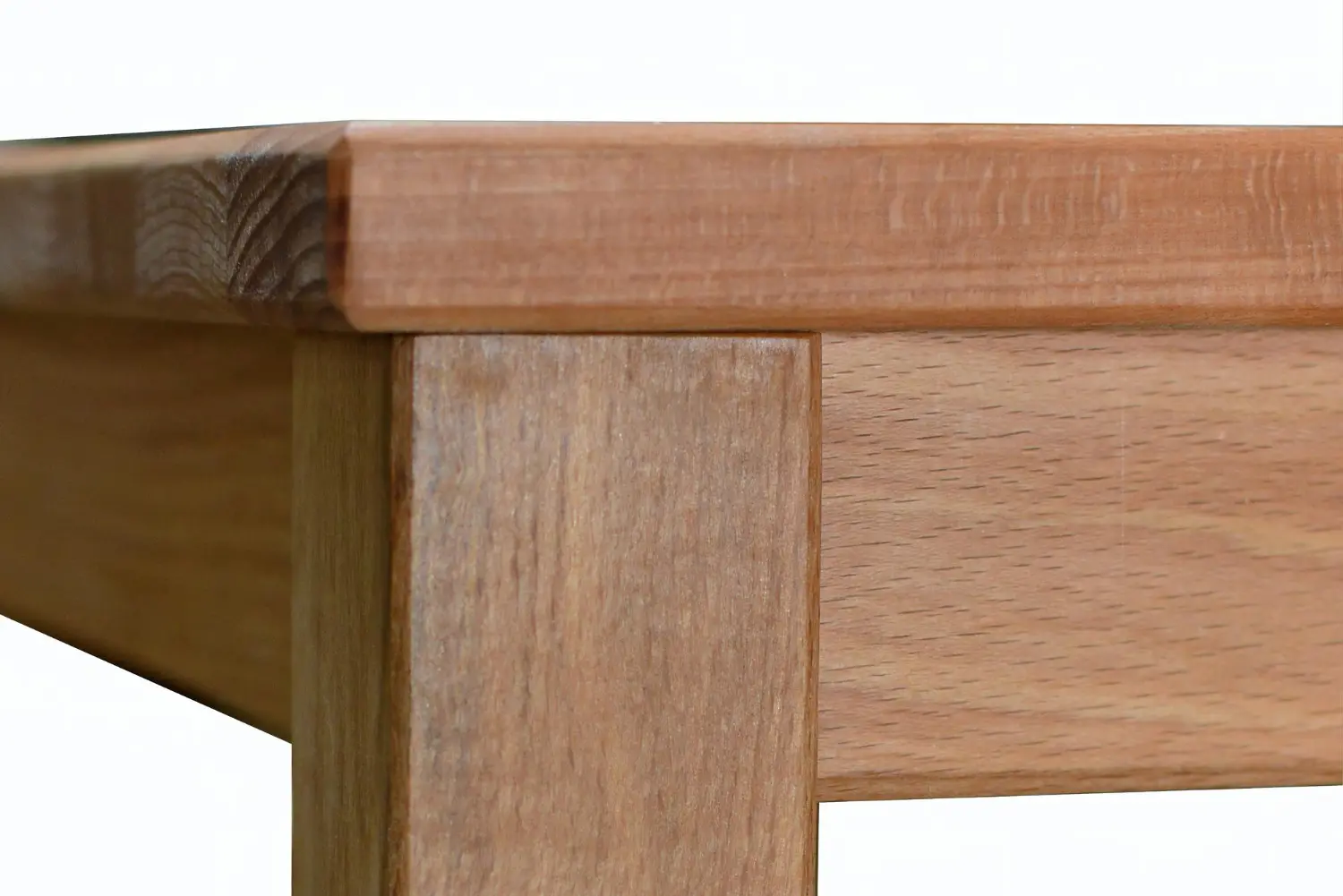
The Edge Guests Feel
Every guest makes contact with the edge within seconds of sitting down. Accordingly the profile carries an ergonomic job alongside its durability one.
Forearm Pressure
A forearm resting on a square arris concentrates pressure along a line, which becomes uncomfortable within a few minutes. Meanwhile a radius or bullnose spreads that contact and disappears from awareness entirely.
This matters most where guests lean for long periods. Our guide to bar counter dimensions covers the counter positions where forearm contact is effectively constant.
Thickness at Eye Level
A seated guest sees the edge in section, not the surface. Therefore the profile does most of the visual work in a dining room, and the top finish does most of it in photographs.
Clothing and Catching
Sharp underside arrises catch sleeves and bag straps. Consequently easing the underside is worth doing even when the visible top edge stays square.
Combining Tops and Matching Edges
Rooms that push tables together for larger parties place a specific demand on the edge. In that case the profile decides whether a joined table reads as one surface or two.
Why Radius Edges Show a Gap
Two rounded edges meeting create a visible valley along the join. However two square edges meeting create a fine line and a pair of chipping points that face each other.
So the honest answer depends on how often you combine. Rooms that join tables nightly favour a minimal eased arris, whereas rooms that join occasionally favour the more durable radius.
Matching Table Top Edge Profiles Across Sizes
Order every top in a room with the same table top edge profile and the same corner radius. Additionally record both figures, because a top ordered two years later will otherwise arrive with the factory default.
Our guide to restaurant table sizes covers which tops actually combine cleanly in the first place.
Tops profiled to your drawing, not to our default setting
Timber, laminate, compact and stone tops cut to size with the edge profile and corner radius specified per order, and held on file for repeat runs.
Cleaning, Cloths and Hygiene
Staff wipe the edge more often than any other part of the table. Consequently the table top edge profile affects daily labour in a way that shows up over a year.
One-Pass Wiping
A bullnose or radius lets a cloth follow the surface around the edge in a single movement. Meanwhile a square edge with a tight underside arris needs a second pass along the underside.
Where Residue Collects
Tight internal angles trap residue, and applied bands create exactly that angle if they sit slightly proud. Therefore a flush or postformed edge is the more hygienic construction as well as the more durable one.
Chemicals at the Joint
Cleaning solution sitting on a glue line does more damage than the same solution on a face. So wipe banded and mitred edges dry rather than leaving them to air.
Choosing Table Top Edge Profiles for Your Room
Work through four questions in order and the right table top edge profile usually resolves itself. Each question narrows the list rather than opening it.
How Hard Does the Room Run?
High turnover with chairs pushed in constantly points to a radius or bullnose. In contrast a quiet dining room can carry a square or lightly eased edge indefinitely.
What Is the Top Made Of?
Material rules out roughly half the table top edge profiles immediately, as the feasibility table above shows. Accordingly settle the material first and treat the profile as a decision made within it.
Do Tables Get Joined?
Frequent joining favours the smallest arris that survives your traffic. Otherwise the more generous profiles win on every other measure.
What Should the Top Look Like?
Finally, decide whether the top should read thick or thin. A chamfer or mitre answers that question directly, whereas a radius leaves the apparent thickness unchanged.
Writing the Table Top Edge Profile Onto an Order
A table top edge profile becomes real only when it appears on paper in numbers. Four lines cover it completely.
The Four Lines
State the profile name, the radius or chamfer dimension in millimetres, whether it applies to the top arris, the underside arris or both, and the corner radius in plan. Consequently the factory default never reaches your room.
Ask for an Edge Sample
Request a short offcut showing the finished profile rather than a photograph. Furthermore run a thumb along it and push a chair back against it, since both tests take seconds and settle the decision.
Keep It on File
Record the table top edge profile alongside the finish schedule for the whole order. Because a repeat run two years later will otherwise arrive with a different edge, this single line keeps a room consistent.
Our table bases and tops range shares profiles across sizes for exactly that reason.
Mistakes Buyers Make With Table Top Edge Profiles
Each of these appears regularly on table orders. Fortunately a single line at enquiry stage removes every one of them.
Leaving the Table Top Edge Profile Off Entirely
An unspecified edge is not a neutral choice, since the factory still has to cut one. Therefore the room receives whatever the tooling happened to carry.
Asking for Square on Veneer or Stone
Neither material holds a sharp arris in service. Consequently the edge that looked crisp on the drawing appears chipped within a season.
Confusing Edge Radius With Corner Radius
These two curves belong to different machining operations entirely. So state both, in millimetres, on separate lines.
Forgetting the Underside
Buyers specify what they can see and leave the underside sharp. Meanwhile sleeves, trolleys and stacking all meet that arris rather than the visible one.
Judging From a Photograph
Table top edge profiles read almost identically in images and feel completely different in the hand. So insist on a physical offcut before approving.
Mixing Profiles Across One Room
Tops bought in two phases with different edges never quite match. Accordingly record the specification with the first order rather than reconstructing it later.
Choosing a Mitred Edge for a Busy Room
A mitred edge places a glue line at the most exposed point on the table. Therefore it belongs on feature tables that stay put, not on a walkway run.
FAQ
What are table top edge profiles?
They describe the shape around the perimeter of a table top, read as a cross-section. Square, eased arris, radius, bullnose, chamfer and mitred cover almost every contract table.
Which table top edge profile is most durable?
A full bullnose survives chair impact best, because it presents no arris at all. Meanwhile a simple 2 to 3 mm eased arris removes most of the risk at a fraction of the visual change.
Can any material take any table top edge profile?
No, and this is the most common specification error. Veneer needs solid lipping before a cutter can shape it, laminate on a core takes banding or postforming only, and stone cannot hold a sharp arris safely.
What does an eased arris mean?
It means the factory has removed roughly 1 to 3 mm from the sharp line where two surfaces meet. Consequently the edge still reads as square while behaving far better under impact.
Is edge radius the same as corner radius?
No. Edge radius describes the curve in section, whereas corner radius describes how rounded the corners look from above, so state both separately in millimetres.
Which table top edge profile suits tables pushed together?
A minimal eased arris joins most cleanly, since two rounded edges meeting create a visible valley. Nevertheless a fuller radius suits rooms that combine tables only occasionally.
Do table top edge profiles affect cleaning?
Yes, noticeably. A radius or bullnose wipes in one pass, whereas tight internal angles and proud banding trap residue and need a second pass underneath.
What should I put on the order?
State the profile name, the dimension in millimetres, which arrises it applies to and the corner radius in plan. Additionally ask for a physical offcut before approving the run.
More in this category