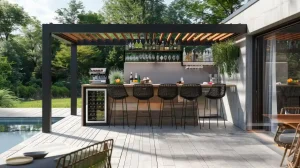

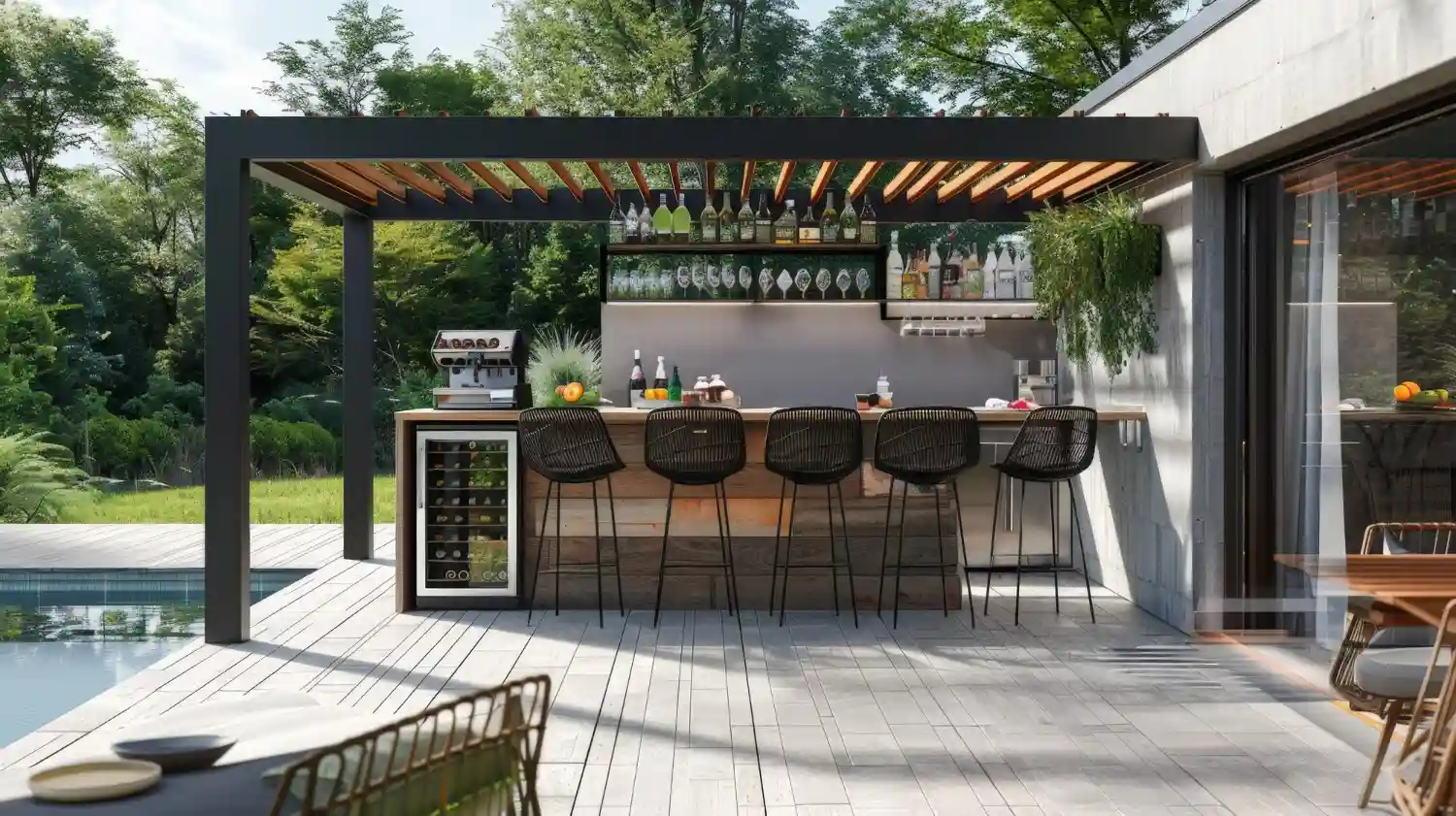
A terrace destroys a stool faster than it destroys a chair, and the reason is geometry rather than weather. Outdoor bar stools are tall, narrow, light and handled twice a day, which is the worst possible combination in wind and rain.
In practice, every failure below follows from that shape. So the specification has to answer the height before it answers the finish.
Below, this guide covers what attacks a stool outdoors, which frames survive, why the footrest fails first, and what to confirm before an order goes out.
Naturally, we have written it from the production side. For the wider sourcing picture, see our guide to restaurant furniture manufacturers.
Specify outdoor bar stools in powder-coated aluminium, marine-grade stainless or a solution-dyed weave over an aluminium frame, and treat the footrest as the critical detail rather than the seat. Ask for a drained or open seat, sealed tube ends, non-marking glides suited to your floor, and stainless fixings throughout. Then plan the handling: a stool at 75 cm seat height blows over in wind that a dining chair survives, so the room needs either weighted feet, a stacking routine or a sheltered position.
Contents
- Why a Stool Fails Before a Chair Does
- The Five Forces on a Terrace
- Frame Materials That Survive
- The Footrest, Where Stools Actually Die
- Seats, Drainage and Sitting on Wet
- Feet, Glides and Terrace Floors
- Fixings, Welds and Galvanic Corrosion
- Wind, Weight and Stability at Height
- Coastal, Poolside and Rooftop
- Stacking, Storage and the Winter Routine
- What to Confirm on the Order
- Mistakes That Shorten a Terrace Set
- FAQ
Why a Stool Fails Before a Chair Does
Put the same frame material into a dining chair and into outdoor bar stools on one terrace, and the stools go first. Four things about the shape explain it.
Height Multiplies Every Load
First, a stool puts a guest’s weight roughly 75 cm above the floor rather than 45 cm. Every wobble, lean and shove therefore arrives at the joints with far more leverage behind it.
Furthermore, outdoor conditions loosen joints anyway through wet and dry cycling. So the two effects compound rather than add.
Water Runs Down and Sits
Second, tall frames collect water along their whole length and deliver it to the lowest joint. Meanwhile the footrest ring, which sits low, catches everything that runs off shoes.
Handling Is Constant
Third, terrace stools get carried in at night, carried out in the morning and dragged along a counter all day. Consequently the finish takes mechanical damage that indoor stools never see.
The Footprint Is Small
Finally, a dining chair spreads its load over four feet set well apart. A stool base is narrower, so the same weight arrives on less floor and the frame flexes more with each guest.
| Factor | Dining chair | Bar stool | Why it matters |
|---|---|---|---|
| Seat height | 45 cm | 65–80 cm | Leverage on every joint |
| Base spread | Wide | Narrow | Flex and tipping |
| Wind profile | Low | Tall | Blows over sooner |
| Foot contact | Floor only | Floor and foot ring | Second wear point |
| Daily handling | Stacked or left | Lifted, often twice | Finish damage |
| Water path | Short | Long, downward | Water gathers low |
The Five Forces on a Terrace
Five things attack a terrace set, and each one damages a different part of it. Naming them separately makes the material choice obvious later.
Ultraviolet Light
First, sunlight breaks down polymers, fades pigment and chalks powder coating. A south-facing terrace ages a finish several times faster than a shaded courtyard.
Notably, seats suffer most, because they face upward all day. That is why a faded seat on a sound frame is the commonest terrace complaint.
Water and Freeze Cycling
Next, water enters through unsealed tube ends, screw holes and coating chips. Once inside a hollow frame it cannot evaporate quickly, and in cold climates it freezes and expands.
The damage therefore appears from the inside out. A frame can look sound and be rotten inside the tube.
Salt
Meanwhile coastal air carries chloride, which attacks steel and even some stainless grades. Salt also settles as a film and holds moisture against the surface between rain showers.
Wind
However, wind is the force people underestimate most. It does not damage the material; it throws the stool over, and the impact damage does the rest.
Chlorine and Pool Chemistry
Finally, poolside air is aggressive in a different way. Chlorine attacks metal fixings and degrades some coatings, and the splash zone stays permanently damp.
Frame Materials That Survive
Frame choice settles most of the outcome for outdoor bar stools. Each material below behaves differently in a stool specifically, because of the height and the foot ring.
Powder-Coated Aluminium
Generally, aluminium does not rust, and a properly pre-treated powder coat holds colour for years. It is the default answer for outdoor bar stools in most climates.
Its weakness is weight, or rather the lack of it. A light stool at bar height is exactly what wind takes first, so ask about weighted feet or a heavier section.
Stainless Steel
By contrast, stainless suits coastal and poolside positions where aluminium looks too light. Grade matters enormously: the common indoor grade will show tea staining within a season near salt water.
Therefore ask for a marine grade in coastal air and confirm that the welds were passivated. An unpassivated weld corrodes long before the parent metal does.
Powder-Coated Steel
Conversely, steel gives weight and rigidity, which solves the wind problem directly. In exchange, every coating chip becomes a rust site, and the foot ring collects the chips.
In short, steel suits sheltered terraces and covered bars rather than exposed or coastal ones. Galvanising under the powder coat extends its life considerably.
Timber
Similarly, teak and acacia genuinely survive outdoors, and they weather to grey unless oiled. On a stool, though, the joints carry more leverage than on a chair, so specify through-tenons or metal-reinforced joints.
Our comparison of dining chair materials covers how each timber behaves; the difference here is the load path rather than the species.
Polypropylene and Moulded Shells
Instead, a moulded seat on a metal frame is easy to clean and takes rain without complaint. Look for a stated ultraviolet stabiliser, since unstabilised polypropylene chalks and turns brittle in one hard summer.
Synthetic Weave
Equally, solution-dyed synthetic weave over an aluminium frame looks softer than bare metal and drains well. Check that the weave is dyed through rather than surface-coated, because a surface-coated strand shows white at every wear point.
| Frame | Weather | Weight | Fails by | Best position |
|---|---|---|---|---|
| Powder-coated aluminium | Excellent | Light | Blowing over, coating chalk | General terrace |
| Marine-grade stainless | Excellent | Heavy | Weld corrosion if unpassivated | Coastal, poolside |
| Galvanised, powder-coated steel | Good | Heavy | Rust at chips | Sheltered, windy |
| Teak or acacia | Very good | Medium | Joint loosening | Sheltered, design-led |
| Polypropylene on metal | Good | Light | Chalking, brittleness | Casual, high turnover |
| Synthetic weave on aluminium | Very good | Light | Strand wear at edges | Lounge terrace |
| Untreated mild steel | Poor | Heavy | Rust everywhere | Indoors only |
The foot ring that rusts from the inside out
Almost every terrace stool that fails early fails at the footrest, and almost nobody inspects it. The ring sits low, so it catches rain running down the frame and everything that comes off wet shoes. Where the ring meets the leg there is a weld, a drilled hole or both, and that is exactly where water enters a hollow tube. Inside, it sits in the dark and works on bare metal that no coating ever reached. The first visible sign is a rust bloom at the joint two years later, by which time the tube wall has already thinned. Ask for sealed or drained tube ends, capped legs and a passivated weld, and add the underside of the foot ring to the monthly walk-round.
One unsealed hole → a frame that rots where nobody looks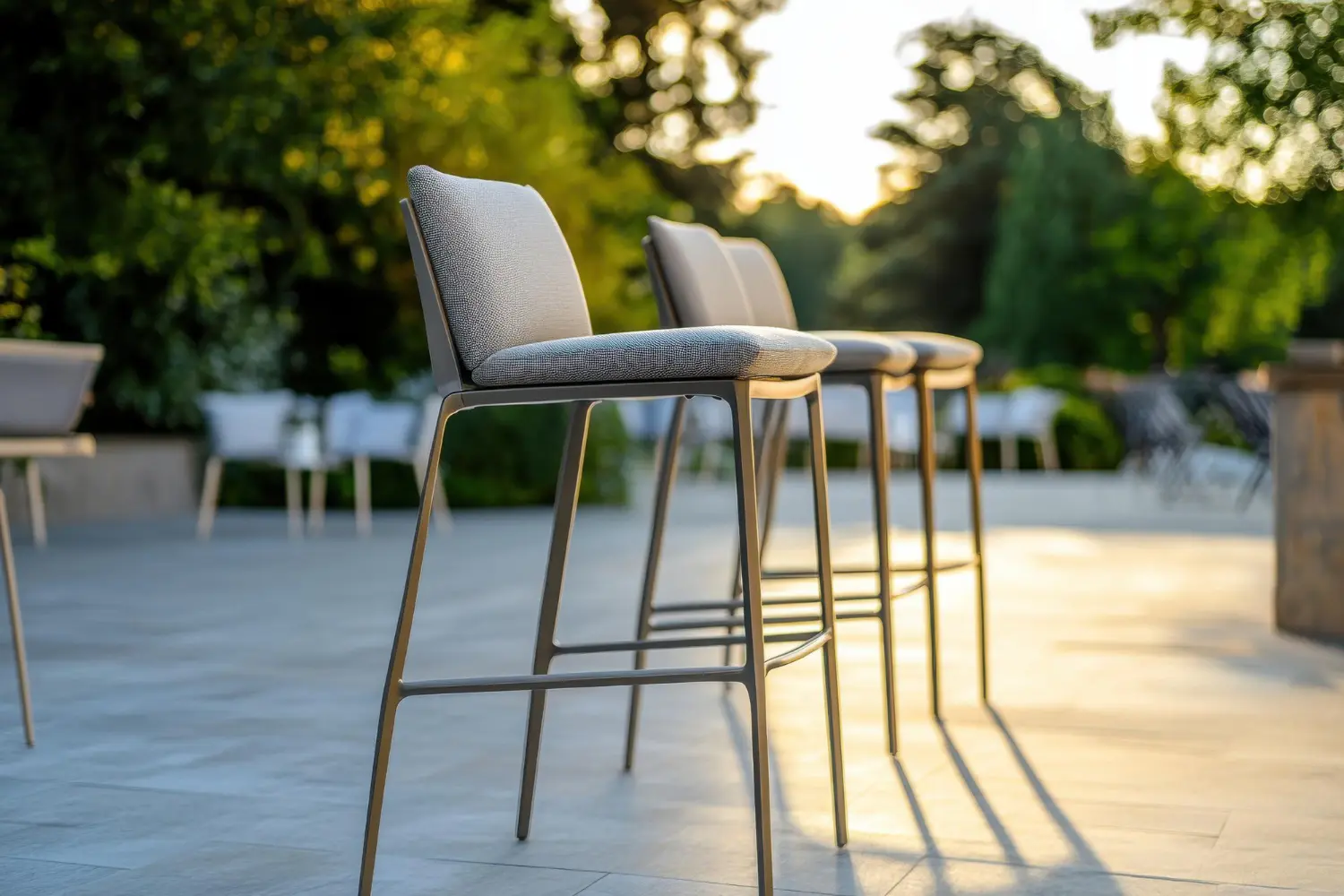
The Footrest, Where Stools Actually Die
The foot ring takes more punishment than any other part of outdoor bar stools, and it is the part buyers never ask about. Three details decide whether it lasts.
Construction and Drainage
First, a ring welded from hollow tube needs either sealed ends or a drain hole at its lowest point. Without one of the two, it fills and holds water permanently.
Alternatively, solid bar avoids the problem entirely and adds useful weight. On an exposed terrace that combination is worth asking for.
Wear Surface
Second, shoes abrade the front of the ring constantly, and outdoors that abrasion cuts through coating to bare metal. A stainless or replaceable wear strip at the contact point solves it.
Above all, check where your guests actually rest their feet. The wear band is usually narrower and lower than the designer assumed.
Height and Position
Our guide to bar counter dimensions sets out the foot rail geometry on the counter side. On the stool, the ring should sit roughly 45 cm below the seat so the thigh stays supported.
Seats, Drainage and Sitting on Wet
Outdoor bar stools have to shed water fast enough that the first guest after a shower does not stand up wet. That is a construction question rather than a covering question.
Open, Slatted and Perforated Seats
For example, slats, perforations and mesh drain immediately and dry in minutes. They are the honest answer for any position without cover.
Padded Outdoor Seats
By comparison, padding outdoors needs reticulated quick-dry foam and a covering rated for weather. Ordinary upholstery holds water, then smells, and our guide to upholstered and non-upholstered seating covers where padding earns its place indoors.
Otherwise, where you specify padding, ask for drainage grommets in the seat pan. A sealed pan with quick-dry foam still traps a litre of water underneath.
Coverings That Hold Colour
Solution-dyed acrylic and marine-grade coated fabrics survive sunlight; ordinary contract fabric does not. Our restaurant chair fabric guide explains the lightfastness scale that decides this.
Surface Temperature
Besides, dark metal and dark coated seats become genuinely too hot to sit on in direct sun. Lighter tones, timber and weave all stay usable through the afternoon.
Feet, Glides and Terrace Floors
On outdoor bar stools the contact with the floor causes more complaints than any material choice. Terrace floors are wet, uneven and easily marked.
Matching the Glide to the Floor
In particular, decking, stone, tile and composite each want a different foot. Plastic glides skate on wet decking, metal ferrules score stone, and rubber marks pale tiles.
Ask the maker which glide ships as standard and whether alternatives exist. A wrong glide takes one line to change at order stage and a workshop afterwards.
Levelling on Uneven Ground
Terraces fall for drainage, so outdoor bar stools that sit level indoors rock once they are outside. Adjustable feet solve it, and they matter more at bar height because the rock is amplified.
Drainage Under the Foot
Moreover, a flat glide on a flat tile traps a film of water that never dries. Slightly domed or ribbed feet let air underneath and stop the staining ring that appears under stored furniture.
Fixings, Welds and Galvanic Corrosion
Two metals touching in wet air corrode faster than either alone, which is why outdoor bar stools fail at their fittings. That meeting point is usually a screw.
Stainless Fixings Throughout
Above all, specify stainless bolts, screws and rivets everywhere, including the parts nobody sees. A plated steel screw in an aluminium frame streaks rust down the leg within a season.
Weld Quality and Finishing
Similarly, an unfinished weld holds contamination and starts corrosion. Ask whether welds are ground, cleaned and, on stainless, passivated before finishing.
Coating Preparation
Notably, powder coating fails at the interface rather than in the film. Chromate-free pre-treatment on aluminium and galvanising under the coat on steel both add years, and neither is visible on the finished product.
Repairability
Of course, terrace furniture gets chipped. Ask for touch-up paint in the order colour and keep it where the maintenance team can find it, since a sealed chip stays a chip.
Terrace stools built for the position they stand in
Powder-coated aluminium, stainless and weave stools with drained frames, stainless fixings and glides matched to your floor.
Wind, Weight and Stability at Height
Wind decides more outdoor bar stools specifications than weather resistance does. A stool that survives ten winters still fails if it spends them on its side.
Why Height Is the Problem
In short, a tall stool presents a large area to the wind with a small base underneath. Even a moderate gust tips one, and the fall damages the coating that was protecting the frame.
Adding Weight Where It Helps
Therefore weight low in the frame does the work; weight in the seat makes tipping worse. Ask for weighted feet, a solid foot ring or a cast base rather than a heavier top.
Base Geometry
Likewise a four-leg splayed base resists tipping better than a straight column of the same weight. Sled and cross bases sit between the two, and they slide rather than fall, which is usually the better failure.
Position and Shelter
Fortunately rails, planters and screens all reduce wind load substantially. Placing the stool run behind a solid element rather than in the open changes the specification you need.
Coastal, Poolside and Rooftop
Three positions are harder than an ordinary terrace, and each one needs its own answer for outdoor bar stools.
Coastal
First, salt rules out plated steel and ordinary stainless. Specify marine-grade stainless or aluminium, rinse the frames with fresh water regularly, and expect the rinse routine to matter as much as the metal.
Poolside
Second, chlorine attacks fixings and coatings, and the splash zone never dries. Aluminium with stainless fixings and open drained seats is the reliable combination, and our outdoor seating range is built around it.
Rooftop
Third, wind at height is a different order of magnitude, and a falling stool is a safety issue rather than a maintenance one. Fixed or ballasted seating, or a strict clearing routine, belongs in the plan from the start.
Covered Terraces and Winter Gardens
A roof removes rain and keeps ultraviolet light, humidity and temperature swing. Consequently these positions still need outdoor specification even though they feel like interiors.
The nightly routine nobody staffed
Terrace furniture is usually specified on the assumption that it comes in at night, and the routine is almost never written down or timed. Thirty stools carried through a doorway and stacked takes a real slice of a closing shift, and the first busy week is when it quietly stops happening. From then on the set lives outdoors permanently, which is a different specification from the one that was bought. Decide honestly at order stage: either buy for permanent exposure, or write the routine into the close-down list with the minutes it takes and the place they go. A set left out by accident ages roughly twice as fast as the same set brought in on purpose.
An unwritten routine → a specification that quietly changesStacking, Storage and the Winter Routine
How outdoor bar stools are stored decides much of their life. Storage is also where the practical differences between models show up.
Stackability at Height
Unfortunately stacking stools is awkward because the stack becomes tall and unstable quickly. Four high is a realistic working limit for most designs, and a trolley makes the difference between a routine that happens and one that does not.
Covers and Trapped Moisture
Meanwhile a cover that does not breathe holds moisture against the frame and does more harm than the rain would. Choose breathable covers, and never cover furniture that is still wet.
Winter Storage
Instead, store off the ground, out of standing water and with air movement between pieces. Dry the foot rings before stacking, since that is where water sits.
The Monthly Walk-Round
Finally, check coating chips, foot ring wear, fixing corrosion and glide condition once a month. Our guide to cleaning restaurant chairs covers the products that are safe on coated frames.
What to Confirm on the Order
Send this list with any enquiry for outdoor bar stools. A supplier who answers every line without hesitation is quoting a genuine outdoor product.
| Item | Ask for | Why |
|---|---|---|
| Frame material and grade | Alloy or stainless grade, stated | Coastal air needs a specific grade |
| Pre-treatment | Process before powder coating | Coating fails at the interface |
| Tube ends | Sealed or drained, capped legs | Stops water entering the frame |
| Foot ring | Solid bar or drained tube | The first part to fail |
| Fixings | Stainless throughout | Prevents rust streaking |
| Welds | Ground and passivated | Welds corrode before parent metal |
| Seat drainage | Open, slatted or grommeted | Guests sit down after rain |
| Covering rating | Lightfastness and water behaviour | Fading is the visible failure |
| Glides | Matched to your floor type | Marking, skating and scoring |
| Stool weight | Per stool, in kilograms | Wind behaviour and handling |
| Stack height | Stated for this model | Storage and close-down |
| Touch-up paint | In the order colour | Sealing chips prevents rust |
Mistakes That Shorten a Terrace Set
Each of these turns up regularly, and each belongs in the outdoor bar stools decision before the order rather than after the first winter.
Buying Indoor Stools for a Covered Terrace
In reality a roof stops rain and nothing else. Humidity, ultraviolet light and temperature swing all continue, so the position still needs an outdoor specification.
Ignoring Wind
Again, weather resistance and wind resistance are separate problems. Ask about weight and base geometry as deliberately as you ask about corrosion.
Plated Fixings
Indeed, one plated screw undoes an entire stainless frame visually. Confirm the fixings, including the hidden ones under the seat.
Forgetting the Floor
The wrong glide marks a new terrace floor within weeks. Name your floor finish in the enquiry so the maker ships the right foot.
Leaving the Foot Ring Off the Inspection List
After all, it is the lowest, wettest and most abraded part of the stool. Look under it monthly rather than annually.
Assuming Someone Will Bring Them In
An unwritten routine is not a routine. Either specify for permanent exposure or staff the handling properly.
Matching Indoor and Outdoor by Appearance Alone
Certainly a terrace stool that visually matches the indoor set rarely shares its construction. Our overview of the types of restaurant chairs covers how to keep the two families reading together.
FAQ
What material is best for outdoor bar stools?
Powder-coated aluminium suits most terraces because it does not corrode and stays light enough to handle. Choose marine-grade stainless in coastal air, and galvanised powder-coated steel where wind matters more than salt.
Can indoor bar stools be used outside?
Not for long. Indoor frames use fixings, coatings and joints that assume dry air, and water entering an unsealed tube damages the frame from the inside where nobody sees it.
How do I stop terrace stools blowing over?
Add weight low in the frame with weighted feet or a solid foot ring, choose a splayed or sled base, and place the run behind a rail, planter or screen. On rooftops, treat it as a safety question and use fixed or ballasted seating.
What seat height should outdoor bar stools be?
Match the counter: roughly 65 cm of seat height for a 90 cm counter and roughly 75 cm for a 110 cm bar. Our guide to how many bar stools you need covers counts and spacing along the run.
Do outdoor stools need drainage?
Yes, in both the seat and the frame. Open or slatted seats dry fastest, padded seats need grommets and quick-dry foam, and hollow frames need sealed or drained tube ends.
How often should terrace stools be checked?
Walk the set once a month and look at coating chips, foot ring wear, fixings and glides. Rinse frames with fresh water regularly in coastal or poolside positions.
Are stacking stools worth it for a terrace?
Yes, provided the storage route actually works. Confirm the stack height for the model you are buying and add a trolley, because a stack that cannot be moved easily stops being used.
What should I send with an enquiry for terrace stools?
Your position and exposure, the floor finish, the counter height and whether the set stays out overnight. Those four answers change the specification more than any preference does.
More in this category