
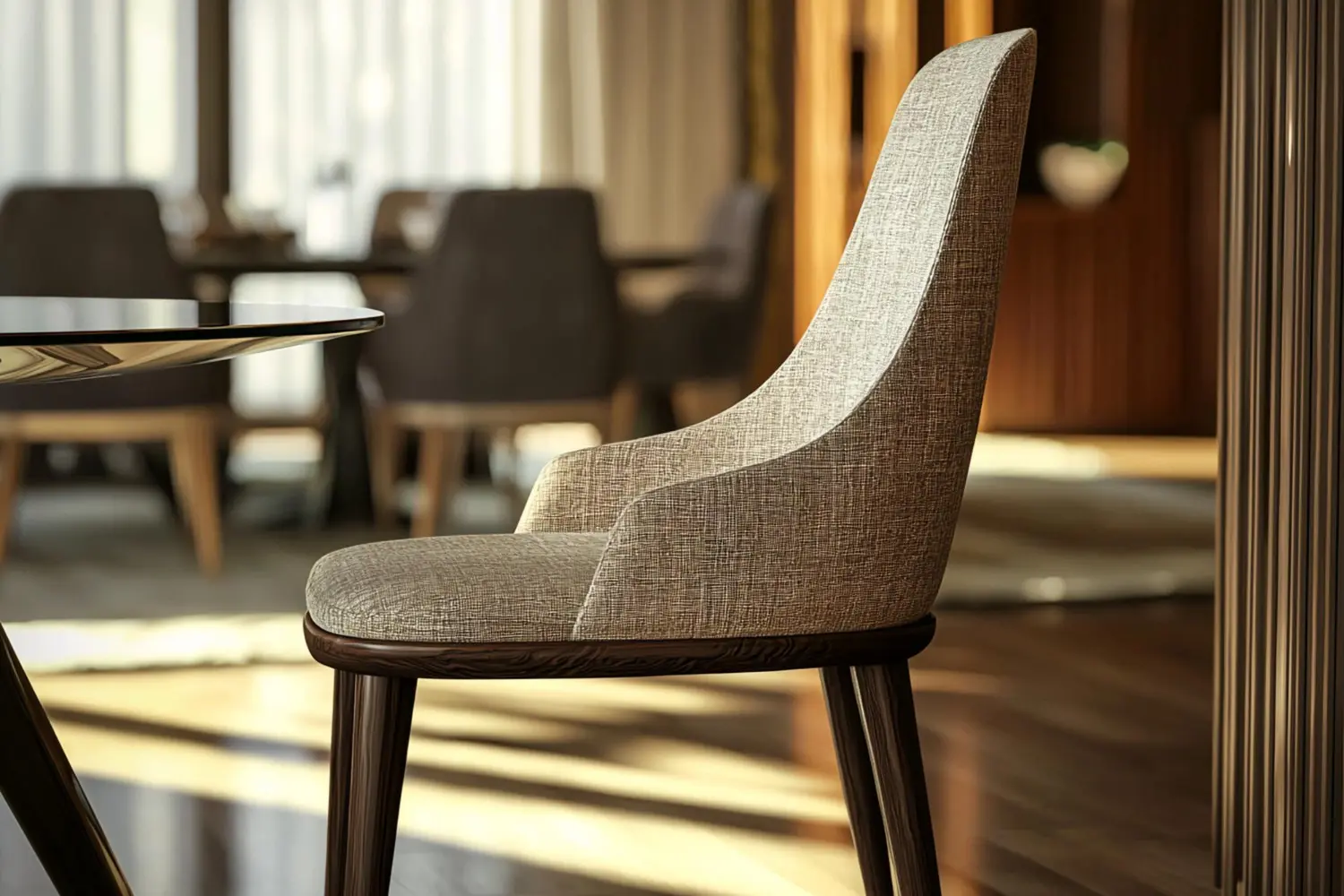
Buyers choose between upholstered restaurant chairs and plain ones on appearance, then pay for that choice every night at close-down. It is a decision about how your room sounds, how long guests stay and how much work a shift ends with.
Both answers are correct in the right room. So the useful question is not which is better, but which failure you would rather manage.
This guide sets out the four build levels, what padding buys you, what it costs you in operation, and how to split the decision by position instead of applying one answer to a whole floor.
We have written it from the production side. For the wider sourcing picture, see our guide to restaurant furniture manufacturers.
Choose upholstered restaurant chairs where guests sit for more than about forty minutes, where the room is hard-surfaced and loud, and where the covering can be cleaned to a written routine. Choose plain timber, metal or moulded seats for fast turnover, terraces, wet areas and anywhere chairs get stacked nightly. Most dining rooms do best with a hybrid: an upholstered seat pad on a plain frame, which gives comfort and acoustic absorption while keeping the back wipeable and the pad replaceable.
Contents
- The Four Build Levels
- What Upholstery Actually Buys
- What It Costs You in Operation
- Where Plain Seats Win Outright
- The Hybrid That Solves Most Rooms
- Acoustics: The Factor Nobody Specifies
- Choosing by Service Model
- Lifespan and the Refurbishment Path
- Mixing Both in One Room
- What to Confirm on the Order
- Mistakes That Follow the Wrong Choice
- FAQ
The Four Build Levels
Our overview of the types of restaurant chairs covers the formats; this page covers how much of each one is padded.
The market talks as though there were two options. In practice there are four, and naming them properly makes the whole decision easier.
Level One: Plain Seat and Back
No padding anywhere. A moulded shell, a solid timber seat or a pressed metal pan, with the shape of the seat doing all the comfort work.
Above all, everything wipes down in one pass. Nothing can stain, split or delaminate, because there is no covering to fail.
Level Two: Upholstered Seat Pad Only
Most upholstered restaurant chairs sold into commercial dining sit at this level. It is worth understanding before the other three.
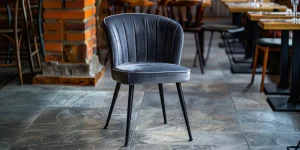
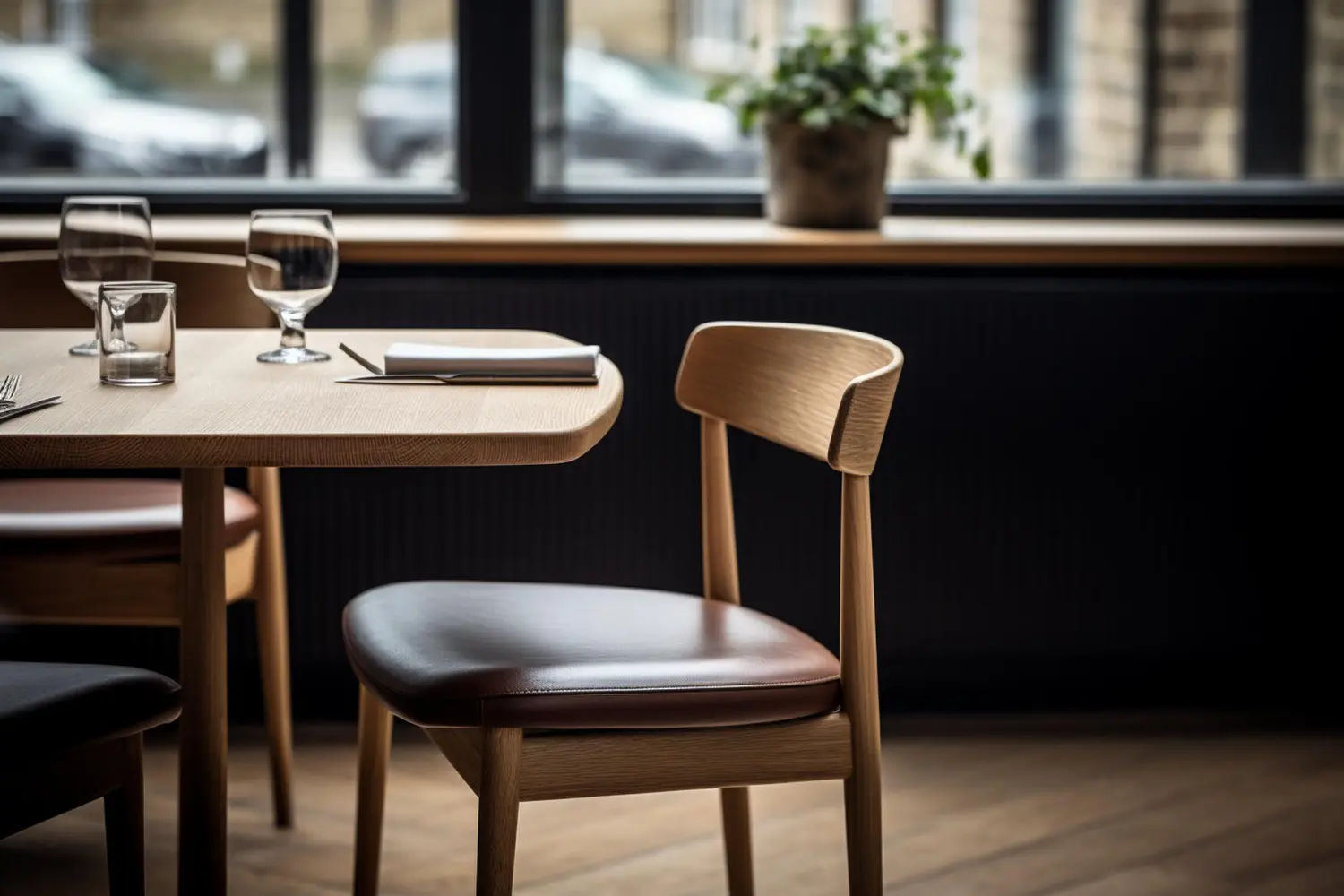
Typically a padded pad drops into or screws under the seat frame, while the back stays plain. This is the most common build in commercial dining, and for good reason.
The pad is where the body weight sits, so the padding is doing useful work. Meanwhile the back stays hard, which keeps it wipeable and keeps the chair lighter.
Level Three: Upholstered Seat and Inner Back
Next, padding on the seat and on the face of the back, with the outer back left in timber or metal. Comfort rises noticeably on the shoulder blades and lower back.
Because the outer back stays hard, the surface guests brush past in a tight aisle is still the durable one. Consequently this build survives dense layouts better than a fully covered chair.
Level Four: Fully Upholstered
Finally, covering wraps the seat, the inner back and the outer back, sometimes with arms as well. This is lounge and fine-dining territory, and it is where upholstered restaurant chairs feel most like furniture rather than equipment.
It is also the most exposed build. Every surface can mark, and the outer back takes damage from trolleys, aisles and neighbouring chairs.
| Level | Padded surfaces | Close-down | Comfort at 60 min | Typical use |
|---|---|---|---|---|
| 1. Plain | None | One wipe | Depends on shape | Fast casual, terrace |
| 2. Seat pad | Seat only | Wipe plus pad check | Good | Casual dining, bistro |
| 3. Seat and inner back | Seat, back face | Two surfaces | Very good | Hotels, long service |
| 4. Fully upholstered | All faces, arms | Full soft clean | Highest | Fine dining, lounge |
| Bench or booth | Seat and back run | Run cleaned as one | Highest per metre | Fixed seating |
What Upholstery Actually Buys
Padding is not decoration. Upholstered restaurant chairs change three measurable things about a dining room, and only one of them is comfort.
Time in the Seat
Generally, a plain seat is comfortable for roughly the length of a quick meal. Beyond about forty minutes, pressure builds at the sitting bones and guests begin to shift, lean and stand.
Upholstered restaurant chairs push that threshold out considerably. Where your service model wants guests to order a dessert or a second round, padding is doing commercial work rather than aesthetic work.
Perceived Quality
Notably, guests read soft surfaces as a signal of a more considered room before they sit down. A padded seat also signals that the room expects them to stay, which changes how the first ten minutes feel.
Our guide to matching restaurant chairs and tables covers how that reading interacts with the table top and the rest of the scheme.
Sound
Furthermore, every soft surface in a dining room absorbs sound instead of reflecting it. Twenty upholstered chairs are a genuine acoustic treatment, and the section below explains why that matters more than most operators expect.
Fit Across Body Types
By contrast, a moulded shell fits the one body shape its designer had in mind. Padding deforms to the guest instead, which widens the range of people who find the chair comfortable.
That flexibility matters most where the same seat has to work for a long lunch and a two-hour dinner. A hard shell that suits one guest can be unforgiving for another.
What It Costs You in Operation
Of course, everything padding gives you arrives with a matching operational obligation. None of these are reasons to avoid upholstered restaurant chairs, although each one needs staffing.
Close-Down Time
First, one wipe cleans a plain chair. A padded seat needs the crumbs lifted first, then a wipe on a coated covering or a brush and a spot check on a woven one.
Across a room of eighty covers, that difference lands on the closing shift every night. Whether that is manageable depends on how you staff the close-down, not on how the chair looks.
Spill Response
Similarly, a spill on a hard seat waits. A spill on a woven seat does not, because the liquid travels into the fibre while everyone is busy.
So a woven room needs a blot-first habit and a spot kit within reach. Our guide to cleaning restaurant chairs sets out the routine and the cleaning codes in detail.
Moisture and Humidity
Moreover, foam holds moisture. In a humid room, near an open terrace door or in a venue that washes floors nightly, that moisture takes far longer to leave than anyone assumes.
Damp foam eventually smells, and no surface cleaning fixes it. Consequently the wetter the environment, the stronger the case for a plain seat.
Weight, Stacking and Storage
Then there is weight: padding adds weight and takes away stackability. A plain stacking chair goes eight or ten high; the same frame with a padded seat usually manages four to six, and a fully upholstered chair rarely stacks at all.
Function rooms feel this immediately. If the room clears twice a week for events, stacking height is a harder constraint than comfort.
Close-down decides this, not the showroom
A buyer sitting in a quiet showroom for ninety seconds judges the comfort. Whoever closes the room at midnight, though, lives with the covering for the next several years. Ask that question directly before ordering: who cleans these, at what hour, with what in their hand, and how many minutes do they have. A woven seat in a room whose closing shift has fifteen minutes and one cloth will look tired within a season, while the same seat in a room with a proper close-down routine will still look right in year four. The chair does not decide this. The routine around it does.
Ninety seconds of showroom → four years of midnightsWhere Plain Seats Win Outright
Several situations rule out upholstered restaurant chairs before comfort enters the discussion. In each of them, a plain seat is not a compromise but the correct specification.
Outdoor and Terrace Positions
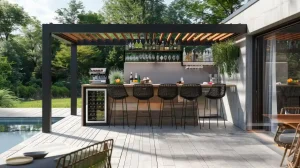
First, rain, ultraviolet light and overnight damp destroy ordinary upholstered restaurant chairs. Terrace bar seating is harder again, and our guide to outdoor bar stools covers it. Unless you are specifying marine-grade coverings with quick-dry foam, an outdoor restaurant chair in aluminium, polypropylene or weave is the right answer.
Conservatories count as outdoor for this purpose. They feel like interior space and behave like a greenhouse.
High Turnover and Counter Service
Where guests sit for twenty minutes, upholstered restaurant chairs buy nothing anyone will notice. Meanwhile the seat still absorbs every spill from a fast, self-cleared table.
Wet and Heavy-Wash Environments
Likewise rooms that hose or mop aggressively, beach venues and poolside terraces all soak the underside of a seat regularly. Moulded and metal seats shrug that off.
Stacking, Function and Storage-Led Rooms
Second, if the furniture has to disappear into a store cupboard, stack height decides the specification. Plain chairs win by a wide margin here.
Rooms That Are Already Soft
A room with carpet, curtains, acoustic ceiling panels and upholstered banquettes does not need soft chairs as well. In that case plain timber adds visual contrast and reduces the cleaning load without making the room louder.

The Hybrid That Solves Most Rooms
The framing of upholstered restaurant chairs against plain ones hides the answer most operators actually want. A padded seat on a hard frame takes the majority of the benefit and leaves most of the burden behind.
Why the Seat Matters More Than the Back
In short, body weight concentrates on the seat, so that is where padding changes the experience. The back mainly needs the right angle and a lumbar shape, both of which a shaped timber or moulded back delivers without any covering.
The result is a chair that feels considerably softer than a plain one while cleaning almost as quickly. For most casual and bistro dining, this is the right level.
Removable Pads Change Everything
Notably, a pad that unscrews from below can be recovered on a bench, or swapped for a spare while the original goes away. A pad stapled through the frame cannot, so recovering later means dismantling a chair.
Ask for the fixing method in writing before ordering. It is the single detail that decides whether refurbishment is realistic in five years.
Hard Outer Back, Soft Inner Face
Therefore, where you want more comfort than a pad alone, keep the outer back hard. That face takes the trolley knocks and the aisle traffic, and it is the surface a passing guest touches.
Our range of indoor restaurant chairs follows these combinations, since they suit the majority of commercial dining rooms.
Spare Pads Instead of Spare Chairs
Finally, holding a small stock of covered pads is far easier than storing whole chairs. Staff then swap a damaged seat during service and repair it later, which keeps the room looking even.
Acoustics: The Factor Nobody Specifies
Sound is where the upholstery decision has its largest and least visible effect. It rarely appears in a specification, and it changes how a full room feels.
Why Hard Rooms Get Loud
In practice, concrete floors, glass, exposed ceilings and hard tables reflect sound rather than absorbing it. Guests then raise their voices to be heard, which raises the ambient level again.
That loop is what turns a pleasant room at half capacity into an exhausting one at full capacity. Nothing about the food changes; the surfaces do.
What Chairs Contribute
Eighty upholstered restaurant chairs represent a meaningful area of absorbent surface, sitting exactly where the sound starts. Unlike a ceiling panel, that absorption sits at head height among the guests.
So upholstered restaurant chairs are worth considering as acoustic treatment in a hard-finished room. They will not replace proper acoustic design, and they will take the edge off it.
When It Does Not Apply
If the room already has carpet, drapes, acoustic plaster or a full run of banquettes, the chairs are no longer the deciding surface. Our comparison of booth and banquette seating covers how fixed seating contributes the same absorption along a wall.
The hard room that empties an hour early
A dining room finished in concrete, glass and bare timber looks superb in photographs and turns punishing at full capacity. Guests lean in, then raise their voices, then leave earlier than they intended, and the operator reads the shortened dwell time as a menu problem. Chairs are not the whole answer, yet they are the one absorbent surface you can add at head height without touching the building. Where the ceiling is exposed and the floor is hard, a padded seat and inner back across the room is worth specifying for sound alone, before anyone talks about comfort.
Hard surfaces → raised voices → shorter tablesChoosing by Service Model
The service model settles the upholstered restaurant chairs question faster than any preference does. Read down to your own operation rather than across the whole table.
| Venue | Typical dwell | Recommended build | Deciding factor |
|---|---|---|---|
| Quick service | 15–25 min | Plain | Turnover and cleaning |
| Fast casual | 25–40 min | Plain or seat pad | Spill volume |
| Bistro and café | 40–70 min | Seat pad | Comfort and noise |
| Casual dining | 60–90 min | Seat and inner back | Dwell time |
| Fine dining | 90–150 min | Fully upholstered | Comfort and appearance |
| Hotel restaurant | Mixed | Seat and inner back | Breakfast to dinner range |
| Bar and lounge | Variable | Coated upholstery | Chemical resistance |
| Function room | 120 min plus | Stacking with pad | Stack height |
| Terrace | Any | Plain or outdoor grade | Weather |
Lifespan and the Refurbishment Path
Frames and coverings age at different rates, and that gap is what makes upholstered restaurant chairs a longer conversation than plain ones.
Plan the cycle rather than the purchase. A frame that carries three coverings serves the room far longer than one that carries a single stapled seat.
The Frame Usually Outlives the Covering
A properly jointed timber or welded metal frame stays serviceable long after the seat looks tired. So the realistic question is not how long the chair lasts, but how many coverings it will carry.
Our comparison of dining chair materials covers frame construction and where each material fails first.
What Makes Recovering Realistic
Three decisions at the original order decide whether refurbishment is practical: a removable pad, a covering still in production a few years later, and a written record of the fabric reference and cleaning code.
Our restaurant chair fabric guide covers the covering specification itself, including rub counts, pilling grades and fire testing.
Plain Seats Age Differently
A timber seat wears through its lacquer rather than its surface, so refinishing restores it. A moulded shell scratches and eventually fades, and it cannot be refinished at all.
Metal frames outlast both, provided the coating is intact. Once the coating is breached, corrosion starts underneath and spreads invisibly.
Planning the Cycle
Decide at the outset whether this room is a refurbish-in-place room or a replace-outright room. That single answer points to a removable-pad build or a plain seat, and it rarely changes later.
Upholstered, plain or both, built on the same frame
Timber and metal frames with plain seats, removable upholstered pads or full upholstery, specified to your fire and rub-count requirements.
Mixing Both in One Room
Specifying upholstered restaurant chairs across a whole floor is the most common error in this decision. Different positions in the same room have genuinely different requirements.
By Position
For example, window seats, corner tables and the quiet end of the room hold guests longest, so padding pays there. Meanwhile the tables nearest the door and the pass turn over fastest and take the most traffic.
Specifying two builds on the same frame keeps the room coherent while matching each position to its actual use.
Banquette Plus Plain Chair
A fixed upholstered run on one side with plain chairs opposite is the classic combination, and it works for a reason. The bench provides the comfort and the acoustic absorption, while the loose chairs stay light and easy to clean.
Our guide to planning a booth seating floor plan covers how to set that run out from a site survey.
Lounge Positions
Equally, softer, deeper seating belongs where guests wait or drink rather than where they eat. An armchair or a banquette in the lounge area does a job no dining chair should try to do.
Bar and Counter
Meanwhile stools live in the wettest, most chemically aggressive part of the room. Coated upholstery or a plain seat both work; woven cloth on a bar stool rarely survives the sanitiser. Our guide to bar counter dimensions covers the counter those stools sit at.
What to Confirm on the Order
Whichever build you choose, the same short list decides whether upholstered restaurant chairs perform in your room. Send it with the enquiry rather than discovering the answers later.
| Item | Ask for | Why it matters |
|---|---|---|
| Pad fixing | Screwed from below, not stapled through | Decides whether recovering is possible |
| Foam density | Contract grade, stated in kg/m³ | Prevents a dished seat within a year |
| Seat platform | Webbing or plywood, stated | Changes feel and covering wear |
| Covering reference | Name, colour, dye lot | Makes later repairs match |
| Cleaning code | On the order acknowledgement | Stops the wrong product being used |
| Fire certification | Fabric and foam together | Compliance is a system, not a fabric |
| Stack height | Stated with the padded build | Storage and function turnaround |
| Chair weight | Per chair, in kilograms | Daily handling by staff |
| Spare pads | Quantity in the same dye lot | Invisible repairs later |
Mistakes That Follow the Wrong Choice
Each of these appears regularly, and each belongs in the decision before the order rather than after delivery.
Choosing Fully Upholstered for a Wipe-Down Room
In practice a fully covered chair in a fast, spill-heavy room looks tired within a season. Match the build to the cleaning routine you actually run, not to the one in the manual.
Choosing Plain for a Long-Service Room
Conversely, guests who are meant to stay two hours will not, on a hard seat. Dwell time drops quietly, and nobody attributes it to the furniture.
Stapled Pads
Again, a pad fixed through the frame turns every future recovering into a rebuild. Ask for screwed pads at enquiry stage, since specifying it takes a line and retrofitting it takes a workshop.
Ignoring Stack Height
Often function rooms discover the padded stack limit on the first turnaround. Confirm the figure with the padded build, not with the plain version of the same frame.
Forgetting the Outer Back
In a dense layout the outer back meets aisles, trolleys and neighbouring chairs constantly. A hard outer face on an otherwise padded chair solves it entirely.
Treating Acoustics as Someone Else’s Problem
You design sound at the same time as the seating, or not at all. Decide early whether the chairs carry part of that load.
One Answer for the Whole Floor
Above all, window tables and door tables do different jobs. Two builds on one frame usually beats a single compromise everywhere.
FAQ
Should restaurant chairs be upholstered?
Upholster where guests sit for more than about forty minutes, where the room is acoustically hard, and where a cleaning routine exists. Choose plain seats for fast turnover, terraces, wet areas and rooms that stack their furniture nightly.
What is the difference between a seat pad and full upholstery?
A seat pad covers only the seat and leaves the back hard, so the chair cleans quickly and stays lighter. Full upholstery covers seat, inner back and outer back, which raises comfort and exposes far more surface to wear.
Are upholstered restaurant chairs harder to clean?
They take longer at close-down and they need the right product for the covering. Coated coverings such as vinyl and polyurethane narrow the gap considerably, since spills sit on the surface rather than soaking in.
Do upholstered chairs make a restaurant quieter?
Yes, measurably so in a hard-finished room, because soft surfaces absorb sound instead of reflecting it. They work best alongside other absorption rather than as the only acoustic measure.
Can upholstered chairs go outdoors?
Only with marine-grade or solution-dyed coverings and quick-dry foam. Ordinary upholstery fails outdoors within a season, and conservatories count as outdoor positions.
How high do upholstered chairs stack?
A padded seat on a stacking frame usually manages four to six, against eight or ten for the plain version. Fully upholstered chairs generally do not stack at all, so confirm the figure before ordering for a function room.
Can I mix upholstered and plain chairs in one room?
Yes, and it usually produces a better result than a single answer everywhere. Keep the frame and the finish common so the room still reads as one scheme.
What should I specify so the chairs can be recovered later?
A screw-fixed removable pad, a covering that stays in production, and a written record of the fabric reference, dye lot and cleaning code. Those three make refurbishment straightforward years later.
More in this category