
Restaurant table tops take more punishment than any other surface in the building, and they are usually chosen from a photograph. Every plate, glass, elbow and cleaning cloth in the room lands on them, several times a service, for years. This guide compares the materials that actually survive that, then covers the half of the decision most buyers leave to the supplier. That is the base underneath, which determines whether the table wobbles and whether it can be cleaned around. It also decides whether an armchair can get near it. You have to specify tops and bases together with the seating. Read it alongside our guide to dining table and chair height and our restaurant table spacing guide.
HPL and compact laminate handle the widest range of restaurant conditions at the lowest lifetime cost. Solid wood suits rooms that will refinish; stone and terrazzo suit rooms that want weight and can accept chipping. Whatever the top, the base carries the wobble — specify both together.
Contents
- Choosing Restaurant Table Tops: What Actually Decides It
- Restaurant Table Top Materials Compared
- Solid Wood and Veneered Tops
- Marble, Stone and Terrazzo
- HPL, Compact Laminate and Melamine
- Table Bases: Column, Cross, Four-Leg and Cantilever
- Weight, Stability and Wobble
- Sizes, Edges and What to Confirm Before Ordering
- FAQ
Choosing Restaurant Table Tops: What Actually Decides It
Four variables settle the choice of restaurant table tops, and appearance is the last of them. The first is your cleaning routine — not the one in the manual, but the chemical a tired closing shift actually uses. Porous stone and oiled timber assume care; laminate and sealed surfaces forgive a fast wipe with whatever is in the bottle. Specify for the routine you will really run and the top stays looking new far longer than any warranty implies.
The second is heat and moisture. Plates arrive hot, drinks sweat, and spills sit until someone notices. A surface that marks under a hot plate is a permanent problem in a restaurant. It will happen on day one and every day after. Ask specifically about heat resistance rather than accepting a general durability claim. The two are not the same, and materials that shrug off scratching can still ring under a warm dish.
Weight, Repairability and Grade
The third is weight, the variable buyers of restaurant table tops most consistently underestimate. A marble top on a light base is unstable. A heavy top on any base is difficult to move for cleaning, hard to combine for large parties, and dangerous to lift. Weight also drives the base cost, because a heavy top needs a heavier and more expensive base beneath it to stay put.
The fourth is whether the surface can be repaired. A joiner can sand and refinish solid timber across a whole room in a closure. Compact laminate cannot be repaired but rarely needs to be. Stone can be re-polished by a specialist at real cost. Veneer and melamine are effectively single-life. That distinction matters far more over ten years than the difference in purchase price does.
Underneath all four sits a question of grade. Contract tables are tested to standards a domestic table never sees. EN 15372 loads the top vertically and horizontally, tests the base for stability when a guest leans on an edge. It then cycles the whole assembly. A domestic table at a similar price has been through none of it. That is why it arrives looking identical and behaves differently within a year. Ask for the standard before you compare anything else. Treat the rest of this guide as a choice between products that already meet it.
Restaurant Table Top Materials Compared
The table below sets the main restaurant table tops against the criteria that show up in service rather than in a brochure. Cost is indexed against melamine-faced MDF at 100, because absolute prices move but the ratios hold reasonably steady. Read the “first failure” column carefully — it is the one that predicts what your room will look like in year three.
| Material | Cost index | Outdoor | Repairable | First failure |
|---|---|---|---|---|
| Melamine-faced MDF | 100baseline | No | No | Edge banding lifts, core swells |
| Veneered MDF | 140–180 | No | Barely | Veneer wears through at edges |
| HPL on core | 150–200 | Sheltered only | No | Edge or core, not the surface |
| Compact laminate | 220–300 | Yes | No | Rarely fails; corners chip |
| Solid timber | 250–350 | Teak or acacia only | Yes — sand and refinish | Joints open, surface marks |
| Marble / stone | 350–600 | Yes, with sealing | Specialist re-polish | Chipped edges, acid etching |
| Terrazzo | 300–500 | Yes | Specialist | Chipping at corners |
| Metal-framed | 180–260 | Yes in aluminium | Coating only | Coating at the edge profile |
What the Comparison Table Shows
Two patterns run through that table. The materials that never need repair are the ones that cannot be repaired, which is fine as long as they genuinely last — compact laminate earns its premium this way. And the expensive materials are expensive twice, because a heavy top demands a heavier base. Read the cost index as a starting figure rather than the whole cost of the decision.
One column deliberately absent from that table is appearance, because every material in it now comes in convincing versions of the others. Laminate reproduces oak and marble closely enough that guests rarely notice, and engineered stone reproduces natural marble more consistently than the quarry does. That means the visual decision and the performance decision have separated. You can very often have the look you want in a material that behaves better than the one it imitates. Choose the behaviour first and the finish second, rather than the other way round. Then pair the result with the seating using our comparison of dining chair materials.
Solid Wood and Veneered Tops
Solid timber is the only one of the restaurant table tops on this list that you can bring back from the dead. A room of oak or ash tops that has taken five years of knife marks, ring stains and scuffing can be sanded and re-lacquered over a two-week closure. It returns looking new. Nothing else on the list offers that, and over a ten-year horizon it changes the arithmetic completely.
Movement, Maintenance and Veneered Alternatives
The trade-offs are movement and maintenance. Solid tops expand and contract with humidity, so makers build them from staves rather than single boards. They need a sensible environment. A top beside a kitchen pass or an open terrace door lives a harder life than one across the room. Finish choice matters more than species: a modern two-pack lacquer resists spills far better than an oiled finish, though oil is easier to spot-repair.
Veneered MDF is the option that looks like solid timber at a lower price and behaves nothing like it. The veneer layer is fractions of a millimetre thick, so it cannot be sanded. It wears through first at the front edge where guests rest their forearms. In a room with high turnover that happens within a couple of years. Veneer belongs in calm rooms — hotel breakfast rooms, function spaces — rather than in busy casual dining.
Where timber is used, the edge detail carries most of the risk. A square arris chips; a small radius or a chamfer survives. Ask for the edge profile as a specific line on the order rather than accepting the factory default. Remember that the edge is also what a cleaning cloth catches on every single day. We make both constructions to size, as solid wood table tops and veneered table tops.
A repairable top is bought once; a pretty one is bought twice
The comparison that matters is not the price of the top but how many times you buy it. Solid timber that gets refinished at year five is one purchase and one closure. Veneer that wears through at the front edge in year two is one purchase, then another. Add the disruption of swapping tops in a trading room. Compact laminate sits between the two — no repair, but no failure either. Decide which of those three stories you are buying before you compare the quotations.
Refinishing solid wood ≈ a fraction of replacement · veneer has no second lifeMarble, Stone and Terrazzo
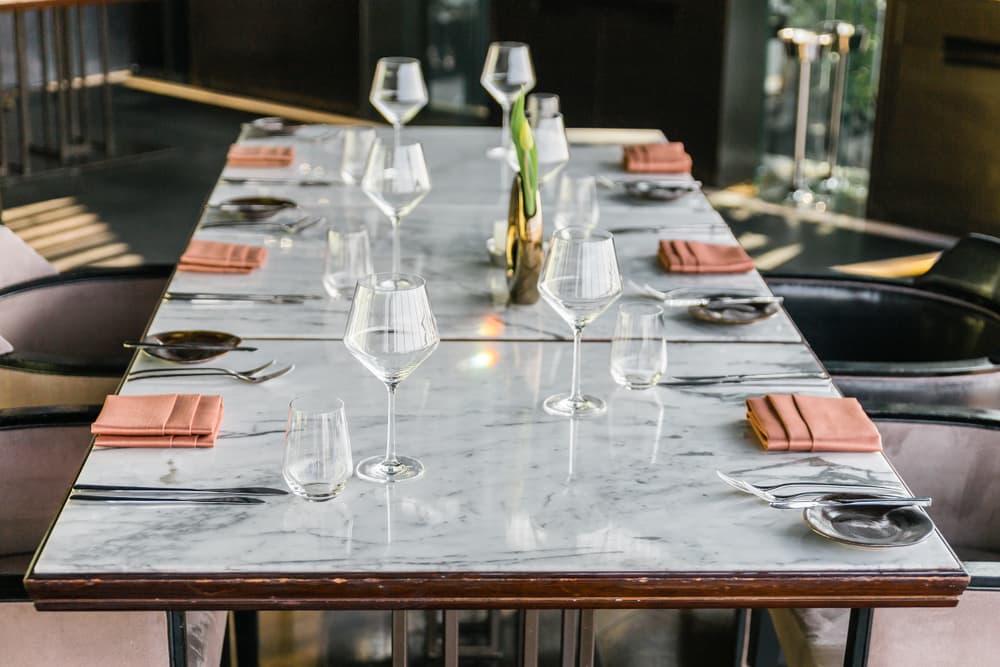
Stone does something no other material for restaurant table tops can: it makes a room feel permanent from across the floor. Marble in particular reads as investment, and in a bar or a fine-dining room that impression is worth real money. It is also the material that most often disappoints buyers who did not ask the right questions before ordering.
The main issue is not scratching but etching. Marble and most limestones are calcium-based. Acid from lemon, wine, vinegar and many cleaning products dissolves the polished surface and leaves a dull mark that no amount of wiping removes. Sealing slows this and does not prevent it. Granite and quartz-based engineered stone resist acid far better and are the sensible choice where the room serves anything acidic, which is every room.
Weight, Chipping and Terrazzo
Weight and chipping are the other two constraints. A stone top needs a base rated for it and a top thickness that survives handling. A thin stone top on a light column is a chipped corner waiting to happen. That usually comes during a table move rather than in service. Specify a substantial base. If the tables will be combined for large parties, accept that stone is the worst material for it: heavy, and vulnerable exactly at the edges that meet.
Terrazzo deserves a separate mention because it solves several of these problems. It is cementitious rather than calcium-based, so it handles acid better than marble. It comes in slabs of controlled thickness, and the aggregate hides small damage in a way a plain polished surface cannot. For rooms that want the weight and character of stone without the anxiety, it is frequently the better answer. Where stone is the direction, our marble table tops cover the usual thicknesses and edge profiles.
Tops and bases matched at the factory
Solid wood, HPL, marble and metal-framed tops on bases rated for the weight — specified as one order.
HPL, Compact Laminate and Melamine
The laminate family is where most restaurant table tops end up. The distinctions inside it matter more than the family name suggests. Melamine-faced MDF is the budget option: a printed decor paper fused to a board. It is fine in a low-traffic room and its failure mode is entirely predictable. Moisture reaches the core at an edge or a screw hole, the board swells, and the top is beyond saving.
High-pressure laminate (HPL) bonded to a chipboard or MDF core is a genuine step up. The surface is a multi-layer resin sheet, so it resists heat, scratching and staining far better than melamine. Its decor range now includes convincing timber and stone effects. The weak point remains the core and the edge. Specify a properly sealed edge, ideally an ABS or postformed profile rather than a thin banding.
Where Compact Laminate Wins and Loses
Compact laminate is the material worth understanding properly, because it removes the core problem entirely. The whole thickness — typically 10 to 13 mm — is resin-impregnated, so there is nothing to swell and no edge to lift. It needs no supporting frame at that thickness, which also means no apron and full knee clearance. The material handles outdoor use, wet cleaning and heat. It is the reason so many terraces and fast-casual rooms look the same after five years as they did on opening day.
Against all that, compact laminate has one real limitation: it cannot be repaired, and a chipped corner stays chipped. In practice this is a minor issue because the material is hard enough that chips are rare. If your room combines tables constantly, choose a radius edge and accept that the corners take the wear. If a cheaper laminate suits the room, our melamine faced MDF table tops sit one step down the same family.
Compact laminate tops for indoors and out
Solid-core HPL with no frame and no apron — full knee clearance, wet-clean tolerant, weatherproof.
Table Bases: Column, Cross, Four-Leg and Cantilever
The base is half of the table, and restaurant table tops get all the attention while it gets almost none. Four families cover almost everything. A single central column with a round or square foot is the most space-efficient and the easiest to seat guests around. Nothing sits where a knee wants to be. It is the default for two-tops and small four-tops.
Cross or spider bases spread the load over four feet and hold larger tops steadily. The cost is feet that a guest can catch a toe on. They suit four-tops and above, and they combine reasonably well when staff push tables together. Four-leg frames, with a leg at each corner, are the most stable of all and the worst for seating. A guest at each corner meets a leg, and any apron connecting the legs eats knee clearance. Our table legs and bases range lists the rated top size for each profile, and metal framed table tops pair the two into one unit.
Cantilever Bases and Adjustable Feet
Cantilever bases — where the column sits at one edge and the top oversails — exist to solve the banquette problem. Against a bench, a central column blocks the guest sliding in; a cantilever lets them slide the whole way along. If you have fixed seating, this is the base type to ask about. It is the one most often missing from a standard catalogue. Our guide to booth and banquette seating covers why you have to specify the table with the bench.
Two more practical notes. Adjustable feet are not a luxury — restaurant floors are never level, and a base without them produces a wobble you cannot fix. And folding or knock-down bases are worth specifying for terrace and function tables. A table that stores flat is a table that survives the winter.
The top is never what wobbles
Guests blame the table; the fault is almost always the base or the floor. An undersized base under a wide top, a base without adjustable feet on an uneven floor, or a column rated for a lighter material than the one on it. Each produces the same wobble. Each is invisible on a specification sheet. Ask for the base’s rated top size and weight, compare it against the top you are actually ordering. Insist on adjustable feet as standard rather than an option.
Base spread should reach roughly two-thirds of the top’s widthWeight, Stability and Wobble
Restaurant table tops do not wobble; bases do. Stability comes from three things: the spread of the base, the weight in its foot, and whether the feet reach the floor evenly. The working rule for spread is roughly two-thirds. A 70 cm square top wants a base foot of around 45 cm. A 120 cm rectangular top wants a pair of bases rather than one. Undersize the spread and the table tips when a guest leans on the edge, which is exactly what guests do when they stand up.
Foot Weight, Floors and Moving Tables
Weight in the foot matters more than the weight of the column. Cast iron feet, or steel plate weighted internally, hold a table still in a way a hollow tube cannot. This is the specification detail that separates a base that costs half as much from one that lasts. It is worth asking for the base weight in kilograms rather than trusting a description.
Floors are the third factor and the one nobody controls. Restaurant floors slope for drainage, settle unevenly and change level at thresholds. Adjustable feet with a decent range absorb this; feet with 5 mm of travel do not. Where a floor is genuinely bad, a three-point base is inherently stable in a way a four-point base can never be. That is a useful trick in older buildings.
Finally, remember that tables get moved. Any base that is stable when static and unmanageable when lifted ends up dragged across the floor by staff, which damages both. There is a practical middle. It is heavy enough to stay put, light enough that one person can shift it, with glides that slide rather than gouge.
Base choice also decides which of your tables a guest in a wheelchair can use. A four-leg frame or a wide cross base blocks the approach; a slim column leaves it clear. The 2010 ADA Standards ask for 68.5 cm of knee clearance height, 76 cm of width and 48 cm of depth beneath the surface. In practice that means a column base and no apron. Mark those positions on the layout and specify their bases separately rather than assuming a standard table will do. Retrofitting later means buying new tables, not adjusting the ones you have.
Sizes, Edges and What to Confirm Before Ordering
Sizing restaurant table tops follows the party mix. Square 70 × 70 cm seats two comfortably; 80 × 80 cm seats four. Rectangular 120 × 80 cm is the workhorse for four and combines into runs. Round tables handle awkward party sizes gracefully — 90 cm seats four, 120 cm seats six — but use floor area less efficiently. Depth of 80 cm is what allows a full place setting on both sides of a rectangular top.
Edge Profiles and Thickness
The edge profile is a bigger decision than it looks. A square arris looks crisp and chips first. Small radii survive daily cleaning and table moves. A postformed or bullnose edge is the most forgiving and slightly softens the look. For any top you will combine with another, radius edges are the only sensible choice. Square edges meeting square edges produce a visible line and a chipping point.
Thickness is worth specifying rather than accepting. Compact laminate at 12 mm needs no frame. HPL on a core typically runs 25 to 30 mm. Stone runs 20 to 30 mm depending on the type and how you support it. Thicker is not automatically better, since it adds weight and weight adds base cost. Too thin looks temporary in a room otherwise specified properly.
Before ordering, confirm four figures in writing. Those are finished top height including the base and glides, underside clearance from floor to the lowest part of the frame, the base’s rated maximum top size, and the top weight. Those four settle nearly every problem that appears on delivery day. Where the tops and the seating come from different suppliers, ask both. The underside clearance figure is the one that decides whether your chairs actually fit. It matters most with the armchairs covered in our guide to the types of restaurant chairs.
Test the sample the way the room will
Get one top in the material you are considering and abuse it for ten minutes. Put a hot plate straight onto it. Leave a slice of lemon and a splash of red wine on it for an hour. Wipe it with the actual cleaner your closing shift uses, not a mild one. Drag a cutlery knife across a corner. Everything that will happen over five years happens in that ten minutes. The top either survives it or tells you now rather than in month three.
Hot plate · lemon · your own cleaner · one corner scratchedTops and bases are easiest to get right when one factory makes both. Our guide to restaurant furniture manufacturers covers custom sizes, edge options and the lead times to plan around.
FAQ
What is the best material for restaurant table tops?
Of the common restaurant table tops, compact laminate suits most working restaurants. It resists heat, water and scratching, needs no frame and suits indoor or outdoor use. Solid timber wins where the room will refinish rather than replace, and stone or terrazzo where weight and character justify the extra cost.
Are marble restaurant table tops practical?
Only with the right expectations. Marble etches when acid touches it — wine, lemon, many cleaners — and sealing slows that rather than preventing it. Granite, engineered quartz or terrazzo resist acid far better and are the sensible choice for any room serving food and drink.
What is the difference between HPL and compact laminate?
HPL is a laminate surface bonded to a chipboard or MDF core, so the core and the edge are the weak points. Compact laminate is resin-impregnated through its full thickness, with no core to swell and no edge to lift. Compact costs more and lasts substantially longer.
What size should a restaurant table be?
Allow 60 cm of table edge per guest and 80 cm of depth for a full place setting on both sides. Square 70 × 70 cm seats two, 80 × 80 cm seats four. A 120 × 80 cm rectangular top is the standard four-top that combines into larger runs.
Which table base is most stable?
A four-leg frame is the most stable and the worst for seating, because a guest at each corner meets a leg. For most rooms a weighted column or cross base with adjustable feet is the better balance. Size it so the base spread reaches roughly two-thirds of the top width.
Why do my restaurant tables wobble?
Almost always the base or the floor rather than the top. Common causes are an undersized base under a wide top and feet with too little adjustment for an uneven floor. A third is a base rated for a lighter material than the one fitted. Adjustable feet with real travel solve most cases.
Can restaurant table tops be used outdoors?
Some restaurant table tops handle weather and some do not. Compact laminate, terrazzo, sealed stone and aluminium-framed tops are fine outdoors. Melamine, veneer and HPL on a wood core are not — moisture reaches the core at the edge and the board swells. Whatever the top, use a weather-rated base and stainless fixings.
Should tops and bases come from the same supplier?
It removes the most common failure, because the base is then rated for the top actually fitted. You confirm the finished height once rather than assuming it twice. If you buy separately, get the base’s rated top size and the top’s weight in writing before either order.
More in this category